
Let me tell you about a gate.
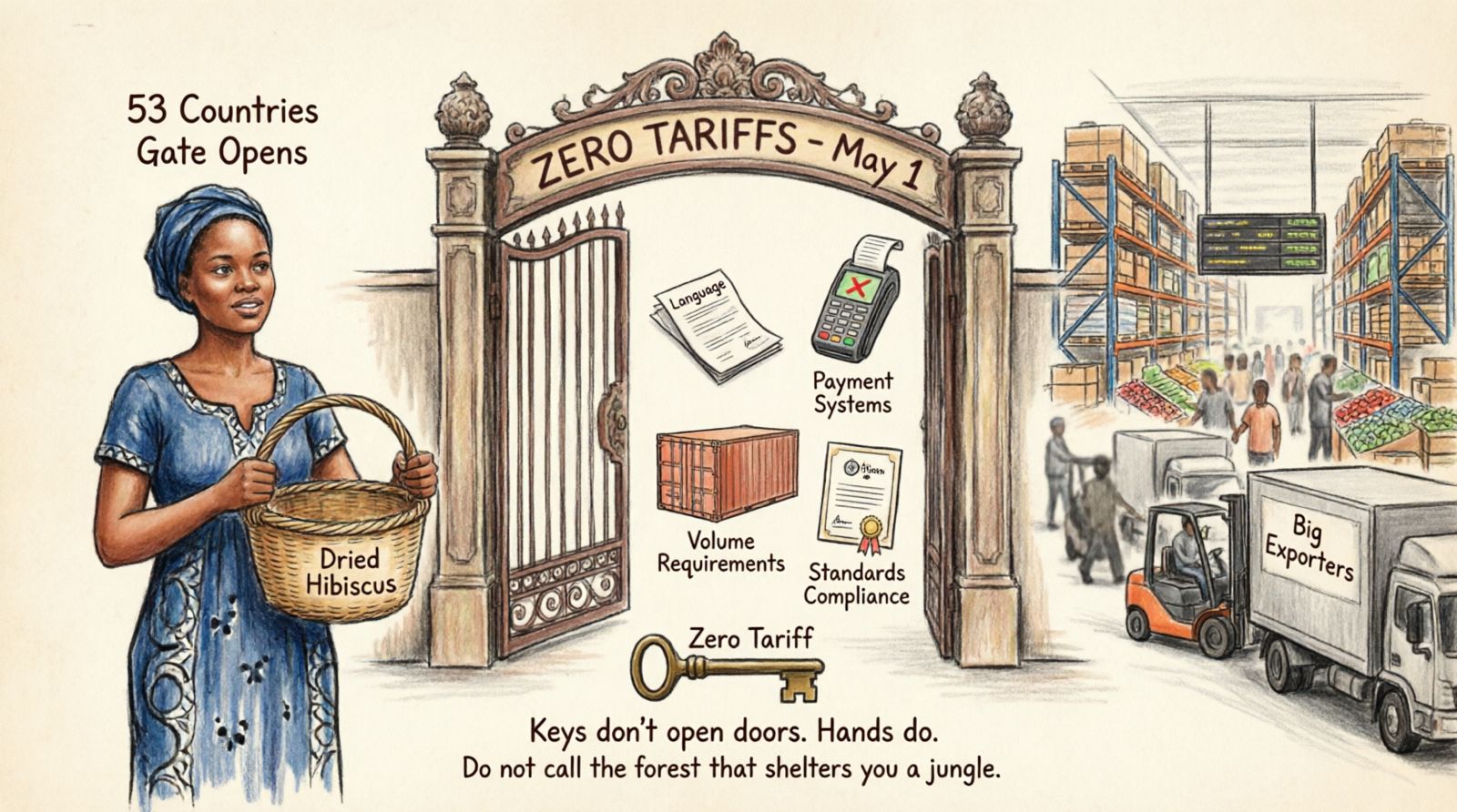
Not a metaphorical one. A physical, iron-wrought, heavily administered barrier that stood between two continents for a very long time. For decades, if you wanted to move goods from West Africa into East Asia, you paid a toll. Not just in money. In paperwork. In delays. In the quiet, grinding friction that never makes the headlines but always shows up in empty pockets and shuttered workshops. Then, on May first, the toll vanished. Fifty-three countries. Zero tariffs. The gate swung open. Beijing called it an invitation to the “big family.” Diplomats shook hands. Cameras flashed. Analysts wrote think pieces.
But gates don’t feed families. Markets do. And the real question was never whether the gate would open. It was what happens once you walk through.
Imagine a sprawling wholesale market in Guangzhou. Miles of aisles. Buyers from every continent. Pallets stacked to the ceiling. Now picture a young woman from Kumasi stepping onto that floor for the first time. She has dried hibiscus, organic, pesticide-free, exactly what the buyers want. The entry fee is gone. She’s inside. But suddenly she’s facing a different kind of wall. The contracts are in Mandarin. The payment platforms don’t recognize her bank. The freight forwarder wants volume she can’t guarantee. The customs broker speaks a dialect she hasn’t memorized. And before she can figure out which form actually matters, the bigger exporters; the ones with warehouses, established shipping contracts, and lawyers who’ve been playing this game for twenty years sweep in, buy her crop at a discount, and move it under their label. She made it through the gate. But she didn’t make it to the counter.
That’s the anatomy of a zero-tariff policy. It removes one barrier. It reveals ten others.
China didn’t open the gate out of charity. Nations don’t operate on charity. They operate on calculus. They need diversified supply chains. They need diplomatic alignment. They need markets that absorb what they produce and feed what they consume. Africa needs infrastructure, export routes, and capital that doesn’t come with political strings attached. When those needs line up, it looks like partnership. When they don’t, it looks like extraction. The difference isn’t in the press release. It’s in the contract. It’s in who sets the price, who owns the logistics, who holds the certification, and who walks away with the margin.
We’ve been here before. I remember when the first export processing zones opened in Lagos and Addis. The promises were loud. The factories were real. But the managers flew in from overseas, the machines were imported, the profits were repatriated, and the local workers stayed on the payroll but off the ladder. Zero tariffs follow the same pattern unless you design them differently. A tariff is just a tax on distance. Remove it, and you’re left with raw competition. And raw competition favors scale, not survival.
So what does this actually mean for the tailor in Accra, the agro-processor in Nairobi, the logistics founder in Mombasa? It means the ceiling just got higher, but the floor didn’t move. It means the young entrepreneur who spent three years perfecting her supply chain now has a shot at a market of 1.4 billion people. It also means she’ll need a freight partner who speaks the language, a payment gateway that clears in forty-eight hours, and a standards certificate that doesn’t expire before the ship docks. It means governments stop treating “export readiness” as a three-day workshop and start treating it as infrastructure. It means African trade associations stop issuing participation badges and start negotiating collective shipping rates. It means the next generation of traders either learns the language, builds the translation layer, or hires someone who does.
The opportunity is real. I’m not dismissing it. I’m just refusing to romanticize it. Doors open. Floors shift. Leverage moves. And leverage, unlike diplomacy, doesn’t care about handshakes. It cares about preparation. It cares about who controls the chain from farm to freight to checkout. It cares about who keeps the value at home instead of renting it out to the highest bidder.
China handed Africa a key. Keys don’t open doors. Hands do. And hands need architecture. Architecture comes from knowing the game, owning the logistics, setting the standards, and refusing to be just another supplier in someone else’s value chain. The tariffs are gone. The playing field is wider. But a wider field doesn’t guarantee you’ll score. It just means you’re no longer playing with a weighted ball.
“Do not call the forest that shelters you a jungle.” — Nigerian Proverb
Partnership only works when you know the terrain. And the terrain just changed. The gate is open. The market is waiting. Now it’s about who walks in prepared, who walks out profitable, and who finally stops confusing access with advantage.
Inspiration: https://english.news.cn/20260519/5a8d6d1ee24a4828936b74701a7c835d/c.html