
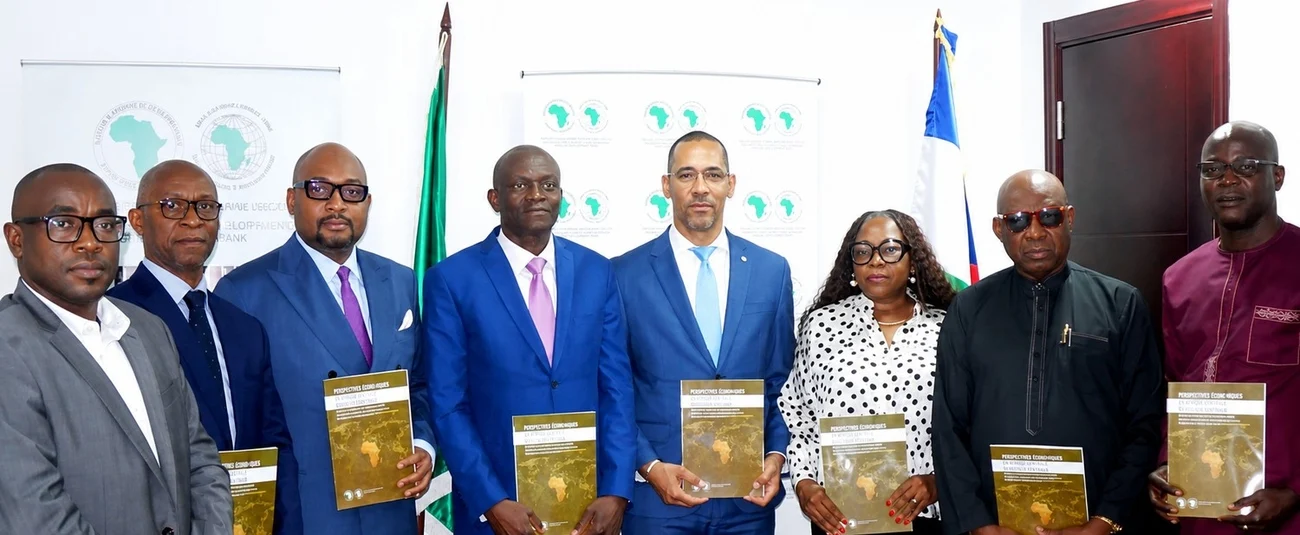
The Central African Republic’s economy grew by 3.3% in 2025. That’s the headline from a new African Development Bank report released in Bangui this August. For a country that has spent years navigating conflict, displacement, and fragile institutions, growth is worth noting. But here’s the part the headline doesn’t capture: growth alone doesn’t change lives. Not unless it’s inclusive, sustained, and wired into the systems that actually serve people.
The report – published in French, so let’s translate for English speakers – argues that CAR’s recovery is real but fragile. It’s driven by agriculture, mining, and a modest rebound in investment. The budget deficit shrank from 5.1% to 3.5% of GDP. The current account deficit improved. Public debt ticked up slightly to 59% of GDP, but remains manageable for now. These are positive signs. But they’re also fragile. Growth is projected to slow to 2.9% in 2026 before picking up to 3.9% in 2027. Inflation is expected to exceed the regional 3% target. And everything depends on three things that are never guaranteed in CAR: security stability, reliable energy, and the actual completion of infrastructure projects.
This is the paradox of recovery in a fragile state. The numbers can improve while daily life stays hard. A farmer may see higher crop prices but still can’t get her goods to market because the road is washed out. A young graduate may have skills but no job because the private sector hasn’t scaled. A clinic may have staff but no power to keep vaccines cold. Growth doesn’t automatically fix these gaps. It just creates the potential to fix them; if the political will, the financing, and the coordination exist.
That’s where the report gets practical. CAR’s National Development Plan for 2024-2028 requires an estimated $12.8 billion. That’s not a number you find under a rock. It has to be mobilized. And the report argues that the old model – waiting for donors to fill the gap – isn’t enough. Instead, CAR needs to tap domestic savings, diaspora remittances, institutional investors, and private capital. It needs to use guarantees, blended finance, local currency instruments, and risk-sharing mechanisms to make projects bankable. In plain English: stop waiting for rescue. Start wiring the systems that let local money fund local development.
This isn’t just theory. It’s the difference between a country that grows on paper and one that transforms in practice. As CAR’s Minister for Economy, Planning and International Cooperation, Marc Mandaba, put it at the report launch: “This recovery remains insufficient to meet the scale of our social needs, create enough jobs and bring about a sustainable improvement in the living conditions of our people.” That’s not pessimism. That’s clarity. Growth is a starting line, not a finish.
For English speakers who don’t read French, the takeaway is simple: CAR is moving in the right direction, but the road is still rough. The next few years will determine whether this recovery becomes a foundation (or just another temporary uptick in a long story of instability). The money can be mobilized. The plans are drawn. The question is whether the systems will be built to turn potential into progress. And whether the world will watch closely enough to hold the right people accountable when promises are made.
Download the 2026 Country Report for the Central African Republic. (French only)