
On paper, Nigeria’s inflation has almost halved. In the market, a different story is playing out. The World Bank explains the gap…
If you’ve heard “inflation is coming down” on the news and then gone to buy rice, garri or tomatoes, you’ve probably felt a disconnect. You’re not imagining it.
The good news, on paper
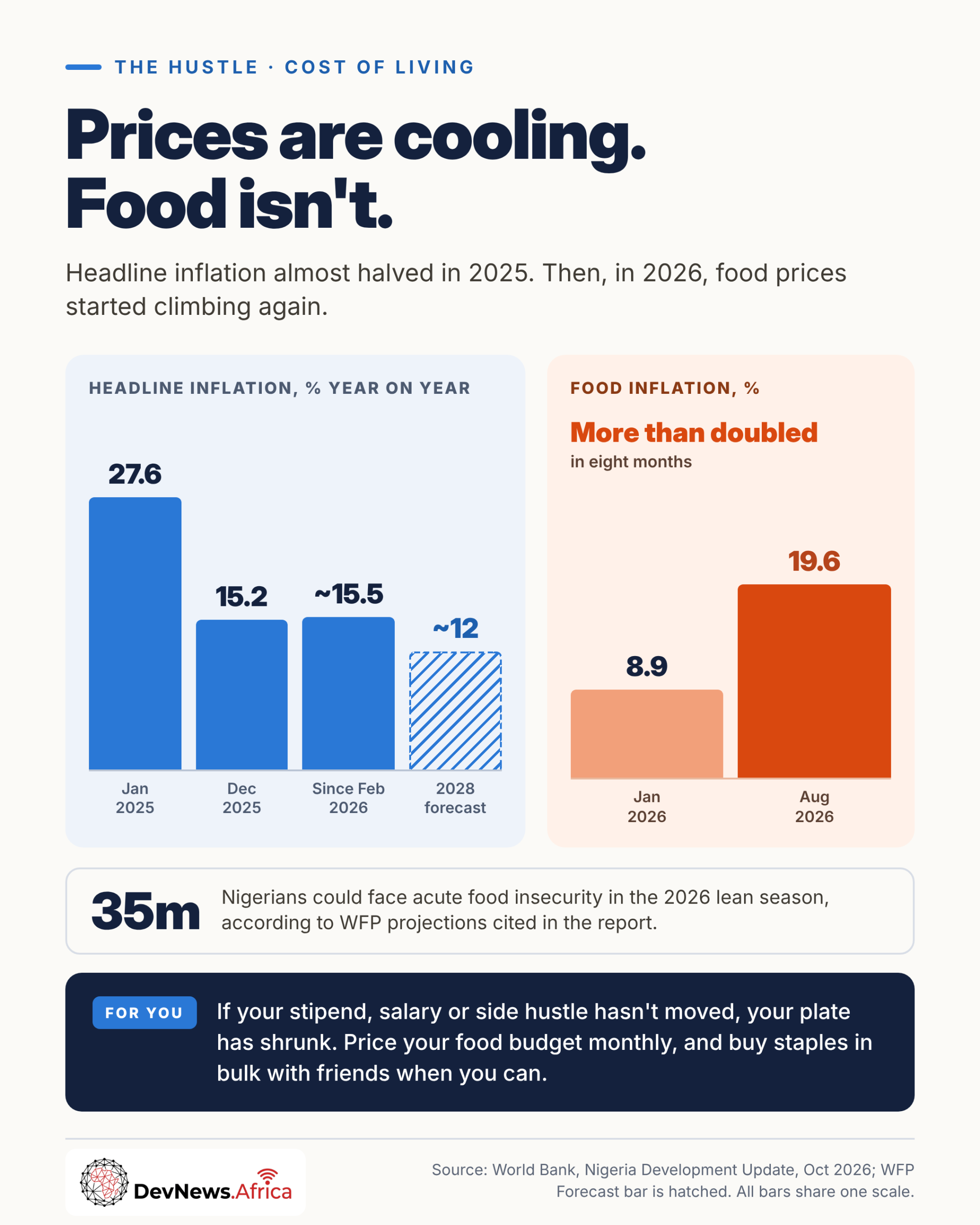
The World Bank’s October 2026 Nigeria Development Update confirms that headline inflation fell sharply last year: from 27.6% in January 2025 to 15.2% in December 2025. That’s close to halving in twelve months.
The wider economy is steadier too. Growth hit 4.2% in the first half of 2026, up from 3.9% a year earlier. Foreign reserves passed $53 billion. In September, the Central Bank cut its benchmark interest rate by 3.5 percentage points to 23%.
The Bank also says poverty has levelled off after rising every year since 2019. But it remains high.
The bad news, on your plate
Then 2026 happened. Since February, headline inflation has stopped falling and hovered around 15.5%. And food inflation went the other way:
- January 2026: 8.9%
- August 2026: 19.6%
The rate at which food prices are rising more than doubled in eight months. The World Bank points to higher fuel prices and the lean season — the months before harvest when food stocks run low.
It gets heavier. World Food Programme projections cited in the report say nearly 35 million Nigerians could face acute food insecurity during the 2026 lean season.
Why young people feel it first
Food takes a bigger bite out of small incomes. If you’re a student on an allowance, an NYSC member on a stipend, or a young worker on an entry-level salary, food is likely your largest monthly cost. When food inflation doubles, your real income takes the hit before almost anyone else’s.
“Levelled off” doesn’t mean “low.” The World Bank projects the poverty rate will only fall to about 61% by 2028. Roughly six in ten Nigerians would still be poor, even in the good scenario.
The Bank expects inflation to ease to about 12% by 2028. That’s progress, but prices that already rose stay high. A slower increase doesn’t mean things get cheaper.
What you can do
- Track your food spend for one month. Write down every naira. It’s the only way to know your personal inflation rate.
- Buy staples in bulk with friends or roommates. A bag of rice or a basin of garri split four ways beats buying in small measures every week.
- Time your big buys. Prices usually soften after harvest. If you can store dry foods, buy more then.
- Ask for a raise with data. If you’re employed, the numbers in this article are a reasonable starting point for a cost-of-living conversation.
- Push for it publicly. Import duties, storage and transport costs all affect food prices. Ask your representatives what they are doing about all three.
Our take at DNA
Macro stability is real, and it matters. But a recovery that shows up in reserves before it shows up in pots of soup is only half a recovery. Until food prices calm down, “inflation is falling” will keep sounding like someone else’s good news.
Sources: World Bank, Nigeria Development Update, October 2026; WFP lean-season projections cited in the report. Report