

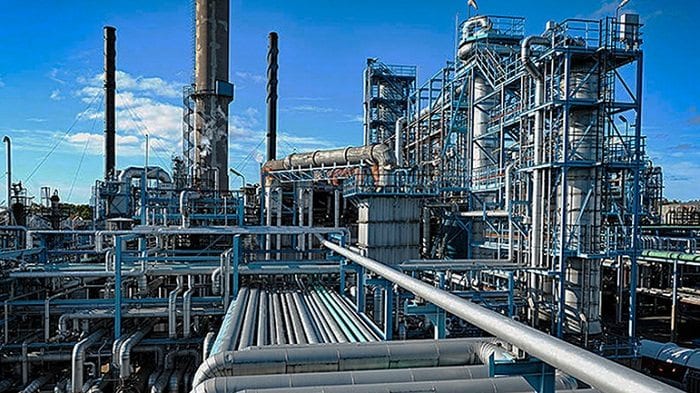
Ghana’s state-owned Tema Oil Refinery (TOR) is considering listing on the Ghana Stock Exchange to raise money for its comeback. If it works, it could mean more locally refined fuel, fewer import costs passed on to consumers, and new jobs in engineering, logistics, finance and industrial services. If it fails, Ghana stays exposed to expensive imported fuel and the refinery’s $517 million debt problem remains unresolved.
TOR’s managing director Edmond Kombat, told an IMF delegation on October 25 that the refinery is exploring a stock-market listing. The idea is simple sell shares to Ghanaian institutions and other investors, raise capital and use it to expand operations.
The catch is that TOR is carrying about $517 million in inherited debt. Around $120 million of that is owed to the state. Management is trying to restructure those obligations, clarify what TOR owes the government and what the government owes TOR and possibly offset some claims against each other.
TOR resumed refining in December 2025 after years of shutdown. It is now running at roughly 28,000 barrels per day, well below its historical capacity of 45,000 barrels per day. Management says it has processed about five million barrels, including nearly two million from Ghanaian fields.
Why It Matters for Your Money
Fuel prices in Ghana are shaped largely by imported refined products. Every cedi spent importing fuel is money that could otherwise stay in the local economy as wages, contracts, taxes and industrial activity.
A functioning TOR does not automatically mean cheaper fuel. Refining economics, global oil prices, taxes and exchange rates still matter. But more local refining can reduce some pressure on foreign exchange, create supply-chain work, and give Ghana more control when global markets get messy.
For young people, the more immediate opportunity is employment. A refinery revival is not just about engineers. It creates demand for:
• Mechanical, electrical, chemical and petroleum engineers
• Lab technicians and quality-control specialists
• Logistics, warehousing and transport workers
• Accountants, auditors, procurement officers and compliance professionals
• Software, data and operations people as the company modernises
TOR also earns money from storage, product transportation to eight private depots, and laboratory services. Those are quieter businesses but they can be more stable than refining itself and they create entry points for graduates who do not come from an oil and gas background.
The Part Nobody Should Gloss Over
This is not a done deal.
TOR has not said when it would list, how much it wants to raise or how much of the company would be sold. That matters. A listing can bring discipline and investment but it can also raise hard questions: Who gets the shares? At what price? Will the state keep control? And will the money actually go into equipment or into clearing old debts?
The technical gap is also real. TOR cannot yet turn Jubilee crude into diesel and petrol that meet national standards without additional equipment including a diesel hydrotreating unit and an gasoline isomerisation unit. In plain terms: Ghana has crude but the refinery still needs investment to convert enough of it into the products people actually buy.
The government wants local production to cover 70% of national fuel needs using TOR and the private Sentuo refinery. That is an ambitious target. Right now, TOR’s recovery is promising but incomplete.
If you are a student, graduate or founder, do not wait for the listing announcement. Track these signals:
• The GSE filing: A real listing moves from “under consideration” to a prospectus, offer price, share allocation and use-of-proceeds plan.
• The debt restructuring: Watch whether TOR reaches a credible agreement on the $517 million debt especially the $120 million owed to the state.
• Capital expenditure: Look for confirmed spending on the diesel hydrotreating and isomerisation units. That is the difference between a refinery that processes crude and one that can produce compliant fuels at scale.
• Local crude supply: Follow whether TOR receives its full GNPC allocation and secures more Jubilee crude.
• Audited accounts: TOR plans to appoint an external auditor. Clean, published accounts would make any future share offer far more credible.
What You Can Do Now
• If you are studying engineering, chemistry, finance, logistics or data: build skills around refinery operations, fuel quality testing, supply-chain analytics, industrial maintenance or ESG reporting. These are practical entry routes into the sector.
• If you are job-hunting: follow TOR, GNPC, Vitol, Sentuo, bulk distribution companies and fuel-transport firms. Opportunities will not only appear at the refinery gate, they will show up across storage, haulage, depots, compliance and trading.
• If you are a founder: look for gaps around laboratory testing, last-mile fuel logistics, digital inventory tracking, safety training, equipment maintenance and data services for depots. A refinery restart creates demand beyond the refinery itself.
• If you are a citizen or investor: ask the useful question not “Is TOR listing?” but “What exactly will the money buy, and how will we know it worked?”
The story here is not simply that a state refinery may go public. It is whether Ghana can turn an old, indebted asset into a functioning industrial business that lowers risk, creates jobs and keeps more value at home. The listing could be the funding route. The real test is whether the machines, crude supply and financial discipline follow.