
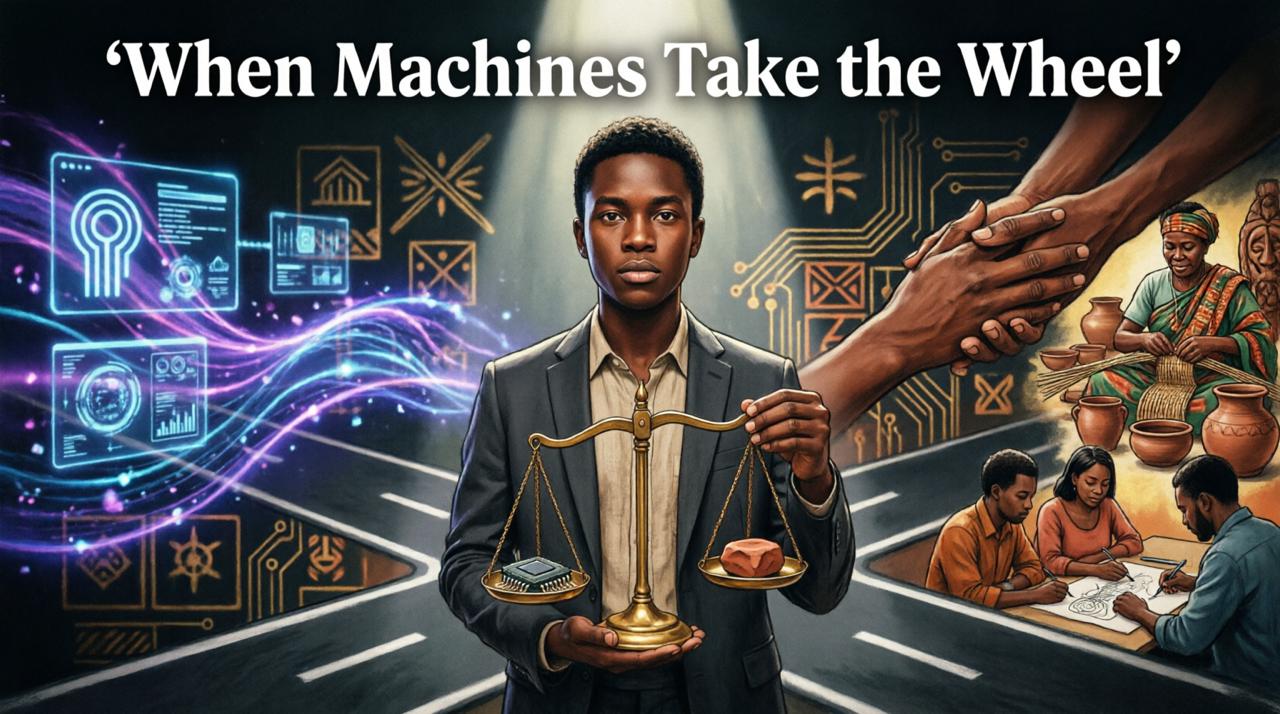
AI is replacing jobs faster than new ones appear. History says “don’t worry, new jobs will emerge.” But what if this time is different?
“The frog that jumps without looking where it lands will end up in the chicken’s mouth.” — West African Proverb
Let’s start with a number that should make you pause: 92 million.
That’s how many jobs the World Economic Forum estimates could be displaced globally by AI and automation by 2030.
Now here’s the twist: The same report says 170 million new roles could be created in that same timeframe. Net gain: 78 million jobs.
So why does it feel like the ground is shifting under our feet?
Because numbers don’t capture timing. They don’t capture transition. They don’t capture the 22-year-old who just spent four years studying a skill that’s now being automated before they even got their first paycheck.
“A river that forgets its source will run dry.” — Yoruba Proverb
History says: don’t panic. When farming jobs disappeared, factory jobs appeared. When typists vanished, software engineers emerged. Technology destroys jobs. Then it creates new ones. The cycle repeats.
But history also says: the transition hurts. And this time, the speed is different. The scope is different. The stakes are different.
THE NUMBERS BEHIND THE ANXIETY
Let’s strip the hype and keep the facts:
Displacement: AI and automation could displace 85–92 million jobs globally by 2026–2030.
Creation: The same forces could create ~170 million new roles—mostly in tech, green economy, and care sectors.
Net effect: On paper, a gain of ~78 million jobs.
The catch: The jobs being lost and the jobs being created aren’t held by the same people, in the same places, with the same skills.
Speed: Goldman Sachs estimates AI is already reducing U.S. employment by roughly 16,000 jobs per month—with Gen Z disproportionately affected.
Scope: MIT research suggests AI can already perform tasks equivalent to 11.7% of the U.S. workforce. McKinsey projects 60–70% of work tasks could be automated by 2030.
In plain English? The math adds up. The human story doesn’t.
THE PATTERN (AND WHY IT FEELS DIFFERENT THIS TIME)
Two hundred years ago, the Industrial Revolution replaced farm hands with machines. Millions lost livelihoods. Millions more found work in factories, railways, and cities. The transition took generations. Pain was real. Progress was undeniable.
Today, AI isn’t just replacing muscle. It’s replacing mind.
It’s not just the assembly line worker. It’s the copywriter, the paralegal, the radiologist, the customer service rep, the junior analyst.
And unlike the steam engine, AI learns. It improves. It scales at the speed of software updates, not infrastructure build-outs.
The question isn’t whether new jobs will emerge. They will.
The question is: Will they emerge fast enough? Will they be accessible to the people who lost their old jobs? Will they pay enough to live on? Will they require retraining that’s affordable, available, and relevant?
“Well done is better than well said.” — African Proverb
Promises don’t pay rent. Paychecks do.
THE HUMAN STAKES
Forget the global totals for a moment. Think about the person behind the statistic.
A young graduate in Accra spent years learning graphic design. Now AI tools generate logos, layouts, and brand kits in seconds. Her portfolio feels obsolete before she even submitted her first job application.
A data entry clerk in Nairobi watched her tasks get automated one by one. Her manager praised the efficiency gains. Her severance package was “generous.” Her next job search has 500 applicants for every opening.
A small business owner in Lagos used to hire three junior staff to manage social media, customer queries, and basic bookkeeping. Now one AI tool does all three. He saved money. They lost income.
These aren’t edge cases. They’re the leading edge of a shift that’s already underway.
And here’s the feedback loop nobody talks about: When people lose jobs, they spend less. When they spend less, businesses earn less. When businesses earn less, they cut more jobs.
It’s not theory. It’s arithmetic.
THE SOLUTIONS BEING DEBATED (AND WHY NONE ARE SIMPLE)
People aren’t just worried. They’re proposing fixes. Here are the big ones—and the hard questions each raises:
Retraining & Upskilling
The pitch: Teach displaced workers new skills for emerging roles.
The reality: Retraining takes time, money, and access. Not everyone can afford to pause earning while they learn. Not every program leads to a job. And if everyone retrains for the same “hot” field, wages drop and competition spikes.
Universal Basic Income (UBI)
The pitch: Give everyone a guaranteed monthly payment, no strings attached. Fund it by taxing automation profits or data usage.
The reality: Pilots in Kenya and Namibia show UBI improves food security, mental health, and economic agency. But scaling nationally requires political will, sustainable funding, and protection against inflation. And UBI doesn’t replace the dignity, structure, or community that work can provide.
Slowing Adoption
The pitch: Regulate the pace of automation to match society’s ability to adapt.
The reality: In a global economy, unilateral slowdowns can mean losing competitive advantage. And who decides the “right” speed?
Worker Ownership & Power
The pitch: Ensure workers have a say in how technology is deployed—and share in the gains it creates.
The reality: This requires shifting power, not just policy. It means unions, co-ops, and new governance models.
“When elephants fight, it is the grass that suffers.” — Swahili Proverb
But when elephants coordinate? The whole ecosystem benefits.
HERE’S WHAT WE THINK AT DEVNEWS.AFRICA
Technology isn’t destiny. It’s a tool. And tools reflect the hands that wield them.
AI will change work. That’s not a prediction. It’s already happening.
The question isn’t whether jobs will disappear. They will.
The question is: What kind of society do we want on the other side of that change?
“The truth is like a lion; you don’t have to defend it. Let it loose; it will defend itself.” — African Proverb
The truth here is simple: Efficiency without equity isn’t progress. It’s extraction.
If the gains from automation flow only to shareholders, while the costs fall on workers, the system isn’t broken. It’s working as designed.
But design can be redesigned.
History doesn’t just repeat itself. It rhymes. And the rhyme scheme is written by people—not algorithms.
“If you want to go fast, go alone. If you want to go far, go together.” — Pan-African Proverb
Africa doesn’t need to choose between technology and humanity. It needs to insist that technology serve humanity—not the other way around.
The machines are learning. Now it’s our turn.
Tell us what you think……