
Africa Day 2026 was unusually busy.
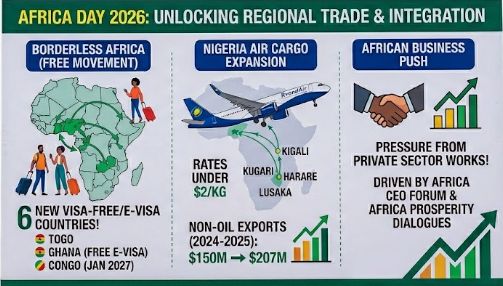
In a single week: Togo went visa-free for all Africans. Ghana launched a free e-visa scheme. Congo announced full visa-free travel starting January 2027. And Nigeria expanded its air cargo corridor to East and Southern Africa through a new partnership with RwandAir, securing cargo rates under $2 per kilogram to Kigali, Harare, and Lusaka, adding to existing routes to Nairobi and Johannesburg.
My first reaction was: this is a massive step in the right direction. My second was: why did so much happen all at once?
The answer is alignment.
Why This Week Happened
The Africa CEO Forum in Kigali produced the bilateral discussion between President Tinubu and President Kagame that directly led to the RwandAir corridor deal. The Africa Prosperity Dialogues in February put 6,530 private sector delegates behind a Borderless Compact demanding visa-free travel. The AfDB and AU Commission held a High-Level Symposium on visa openness the same month.
These were not separate conversations. They were the same conversation finally producing simultaneous action.
What changed is who is pushing. This is no longer primarily civil society advocacy. It is African businesses telling governments directly that border friction and logistics costs sit on their bottom lines. When the person making that argument is not an activist but an investor or exporter with revenue at stake — the pressure lands differently. This week, it produced results.
The Economic Case
Intra-African trade accounts for roughly 15% of the continent’s total trade. Intra-European trade sits at 60%. That gap has two components — tariffs, which the AfCFTA is progressively addressing, and the physical cost of moving people and goods, which this week’s announcements are beginning to close.
The East African Community’s open movement regime has consistently produced stronger intra-regional trade than comparable African blocs. Nigeria’s cargo corridor is showing the same pattern. Before it existed, Nigerian exporters paid between $3 and $10 per kilogram to reach East African markets. Nigeria’s non-oil exports to African markets have already grown from $150 million in 2024 to $207 million in 2025 — a 38% increase in one year. The corridor is working.
Six countries going visa-free and one major air corridor expanded in a single week is significant. The 10th Africa Visa Openness Index reminds us that only 28.2% of intra-African travel is currently visa-free — there is a long way to go. But the friction is losing.
What This Means for Businesses
The policy doors are opening. For private enterprises, the question shifts from why aren’t borders open? to how do we actually use this?
When cargo rates drop below $2 per kilogram to Kigali, Harare, and Lusaka, the logistics mathematics changes overnight. Products that were previously too expensive to export profitably suddenly have viable margins. The first-mover window is open right now.
Rethink which products make sense for air cargo. Lower logistics costs mean premium, high-value, time-sensitive goods, wellness products, cosmetics, specialty nutrition, fashion, suddenly have a genuine business case in markets that were previously out of reach. Agribusiness, textiles, processed foods, and light manufacturing are where Nigerian producers already have comparative advantage. The corridor creates immediate price competitiveness in all of them.
Map the local norms, not just the tariffs. A visa-free policy means people can cross borders. It does not mean consumer behaviour is identical across those borders. What sells in Lagos does not automatically sell in Kigali. Successful cross-border expansion requires understanding local preferences, purchasing behaviour, and cultural context — not just the trade agreement terms. This is where behavioural economics meets business strategy. Most businesses skip this step and wonder why their regional expansion stalls.
Build subnational supply networks. The real opportunity is not city to city; Lagos to Nairobi, Accra to Johannesburg. It is more granular. The textile producer in Aba. The cosmetics manufacturer in Kaduna. The agro-processor in Kano. The cargo corridor was built for them. The Nigerian government specifically noted women-led and small enterprises among early pilot participants. The businesses that connect specific production clusters directly to regional consumer markets will capture value the large players miss.
For decades, African integration has been a story of frameworks without implementation. What is different about this moment is the enforcement mechanism; private sector pressure with capital at stake producing real policy action. The infrastructure is arriving. Not all at once. But arriving.
The businesses that win from this will not simply be the ones who saw the policy change coming. They will be the ones who adjusted their models before everyone else caught up.
That window is open right now.