
For decades, African security meant one thing: conflict. Armed groups. Border skirmishes. Terrorism. Troop deployments. Peacekeeping mandates.
But as the continent builds cancer treatment centers, scales critical mineral mining, digitizes supply chains, and opens trade corridors under the African Continental Free Trade Area, a different kind of threat is emerging. Not from warzones. From warehouses. From laboratories. From shipping containers crossing newly liberalized borders.
Chemicals for pharmaceutical manufacturing. Radioactive sources for medical imaging. Biological samples for disease surveillance. Industrial compounds for battery production.
These aren’t weapons. They’re the backbone of modern development. But if they’re poorly tracked, weakly regulated, or deliberately diverted, they become catastrophic.
The challenge isn’t stopping progress. It’s securing it.
“A gate left unwatched invites the thief.” – West African Proverb
Africa is opening its gates. Now it needs the eyes to watch them.
THE QUIET SHIFT: SECURITY AS INFRASTRUCTURE
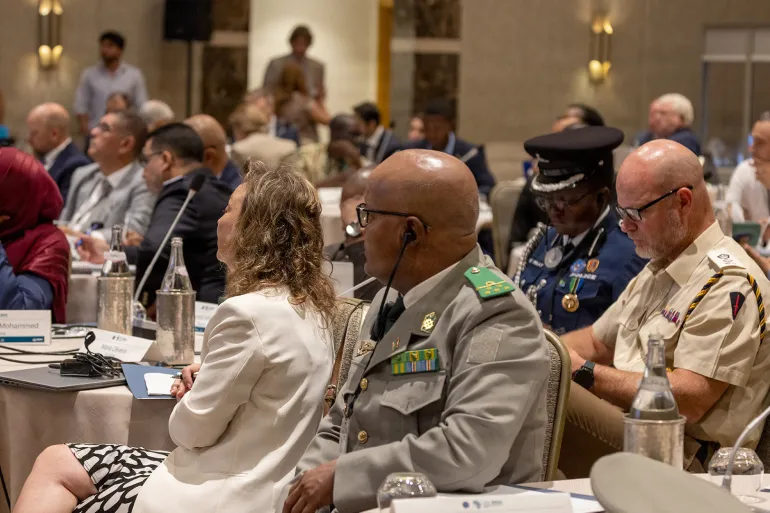
Last week in Tunis, over 100 regulators, customs officials, law enforcement officers, and policy coordinators gathered for Africa Shield 2026. Not to discuss troop movements. To discuss tracking systems, export licenses, border scanners, and inter-agency data sharing.
Organized by the US Defense Threat Reduction Agency, the EU CBRN Risk Mitigation Initiative, and UNICRI, the workshop marked a deliberate pivot: from reacting to crises to preventing them.
For years, CBRN (chemical, biological, radiological, nuclear) security was treated as a niche, almost sci-fi concern. In reality, it’s everyday operational governance. The same materials that power healthcare, scientific research, and industrial scaling require strict handling protocols, chain-of-custody documentation, and cross-border verification. When those systems are weak, gaps appear. And gaps get exploited.
Mubarak Aliyu, a Nigeria-based security analyst, put it plainly: “The challenge is not to restrict development, but to ensure that innovation is matched by effective oversight, secure handling practices, and robust regulatory systems that prevent diversion or misuse without slowing economic progress.”
Security, in this context, isn’t a barrier. It’s an enabler.
“Well done is better than well said.” – African Proverb
Policies don’t secure borders. Systems do.
THE FRICTION POINT: OPEN TRADE VS. CLOSED LOOPHOLE
Here’s where it gets complicated.
Africa is actively dismantling trade barriers. The AfCFTA is designed to move goods faster, cheaper, and more freely across 54 countries. But those same corridors that facilitate legitimate commerce can also be exploited to move controlled materials illicitly.
Many African nations already have legal frameworks regulating hazardous and strategic materials. The problem isn’t the law. It’s the ledger.
Customs officers often lack modern scanning equipment. Regulatory agencies operate with understaffed forensic labs. Intelligence sharing stalls at national lines. And cross-border smuggling networks – already adept at moving weapons, narcotics, and counterfeit goods – know exactly where the blind spots are.
Phil Efe Benard of the African Chamber of Content Producers noted the daily reality: “Monitoring shipments, securing materials, and sharing intelligence across borders are daily struggles compounded by limited resources and exploited smuggling routes. We cannot rely solely on foreign partners. Building our own intelligence, forensic capacity, and regional networks is essential.”
That last sentence is the hinge. Africa Shield isn’t about importing security. It’s about institutionalizing it. Major Brittany Brown of DTRA emphasized that participating countries are “clearly demonstrating their ownership of the counterproliferation problem set,” framing the workshop as a multilateral investment in African-led capacity, not long-term dependency.
“When the moon is shining, the cripple becomes hungry for a walk.” – Zulu Proverb
The moon is shining. But walking requires a path that’s mapped, guarded, and jointly maintained.
THE HUMAN STAKES (BEYOND THE ACRONYMS)
Forget the policy jargon for a moment. Think about the person behind the protocol.
A radiation oncologist in Kampala relies on a secured medical isotope to treat pediatric cancer patients. If the supply chain is compromised or the source is mishandled, treatment stops. Lives pause.
A customs agent in Tema scans a container labeled “textile machinery” that could legally hold industrial chemicals – or illegally hold unregulated compounds. Without proper training and equipment, the difference is invisible.
A mining engineer in Lubumbashi handles cobalt and lithium processing agents that fuel the global battery revolution but require strict environmental and safety controls. Weak oversight doesn’t just risk security. It risks ecosystems, communities, and export credibility.
Security isn’t abstract. It’s operational. And when it works, it’s invisible. When it fails, it’s catastrophic.
HERE’S WHAT WE THINK AT DNA
Security used to mean walls. Now it means systems.
Africa Shield 2026 isn’t about fear. It’s about foresight. The materials that will power Africa’s next industrial, medical, and technological leap are already here. The question isn’t whether the continent can develop. It’s whether the institutions built to guard that development will keep pace.
“The truth is like a lion; you don’t have to defend it. Let it loose; it will defend itself.” – African Proverb
The truth here is simple: You cannot build a modern economy on fragile oversight. You cannot scale healthcare, mining, or trade without secure supply chains. You cannot protect sovereignty by outsourcing it.
The workshop in Tunis was a starting line, not a finish. Laws exist. Frameworks are drawn. Partnerships are active.
Now it’s about who funds the scanners, who trains the officers, who shares the data, and who refuses to let development outpace diligence.
“If you want to go fast, go alone. If you want to go far, go together.” – Pan-African Proverb
Africa’s next security battle won’t be won on battlefields. It’ll be won in customs halls, in regulatory offices, in cross-border data networks, and in the quiet, unglamorous work of consistent implementation.
The materials are moving. The question is whether the systems are ready.