
Let us talk about where the money actually lands. For years, Nigerian policy conversations revolved around federal allocations, central bank adjustments, and macroeconomic forecasts that felt distant from daily reality. But something has shifted. State governments are collecting more revenue. Reforms in fuel pricing and foreign exchange have widened the fiscal base. And the real question is no longer whether money is coming in. The question is whether it is being wired to the places that actually change lives.
“A river that forgets its source will run dry.” — Yoruba Proverb
States are finally holding more water. Now we need to see where the channels are being dug.
Follow the Money: What the Numbers Say
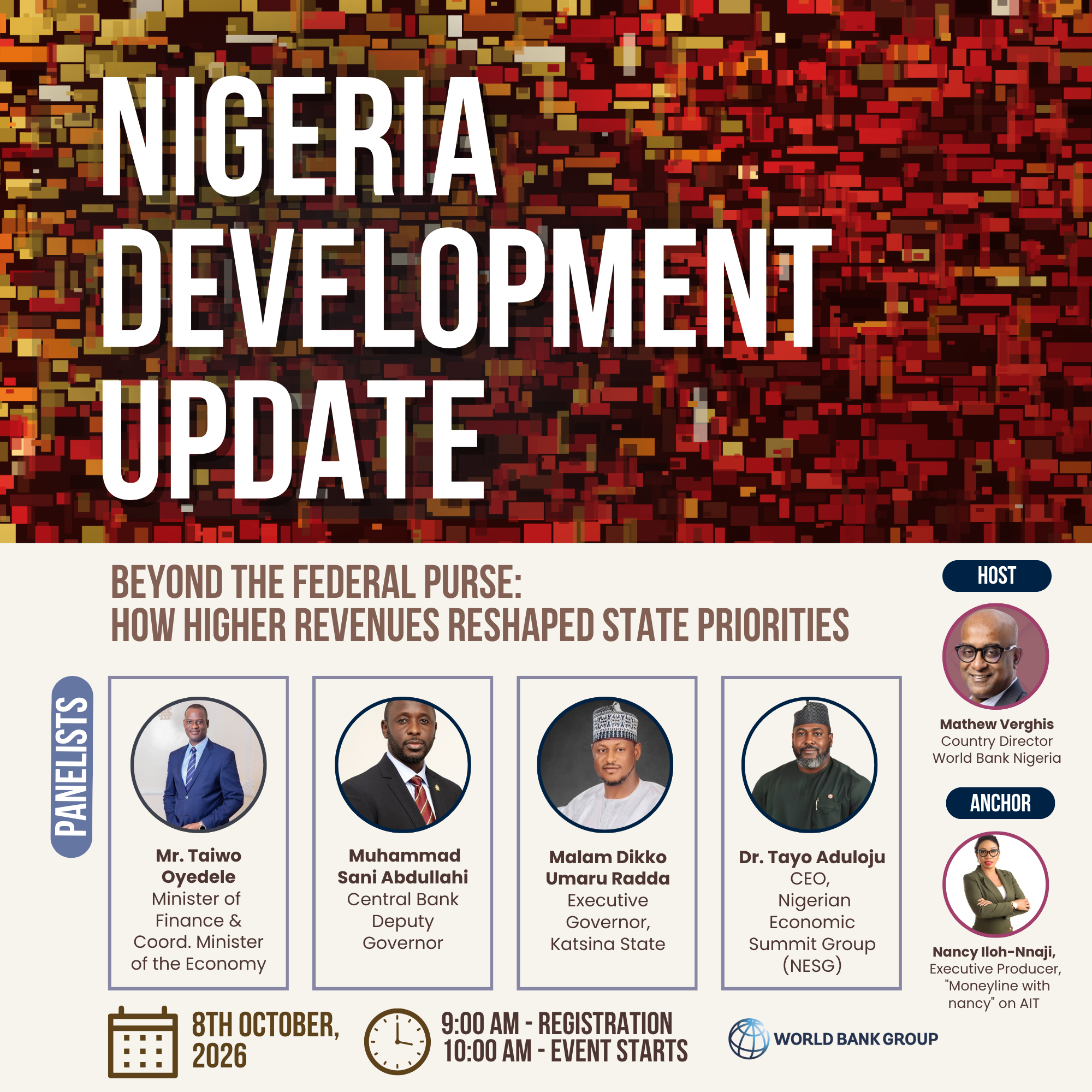
The World Bank launched the Nigeria Development Update in Abuja today 8th October, 2026, and the data tells a clear story. The economy is stabilizing. Inflation has recorded three consecutive months of disinflation. Growth is projected at 4.3% for the year, slightly ahead of population expansion. Capital income has risen by roughly 15%. The Central Bank is holding the Monetary Policy Rate at 23%, keeping liquidity tight until inflation moves closer to single digits.
Macro stability is the foundation. But foundations do not feed people. Infrastructure does. Services do. Jobs do.
That is where state-level execution enters the frame. Katsina State provided a working blueprint. The administration shifted spending away from non-essential items and directed resources toward projects that lower the cost of living and expand access. About 170 new schools have been built. Primary healthcare is being restored across wards, with 268 of 361 facilities now functional, including 24 operating around the clock. An emergency ambulance network is stationed along major corridors. Thirty megawatts of solar electrification are coming online to stabilize power and reduce household energy costs.
This is not charity. This is reallocation. When states stop funding vanity projects and start funding functional systems, the multiplier effect hits immediately. Lower transport costs. Fewer clinic closures. Predictable power for small businesses. Classrooms that actually hold students.
The Human Stakes
If you are a university student, this revenue shift dictates where internship pipelines, research grants, and public-sector hiring will concentrate. If you are a fresh graduate, it maps the sectors that will absorb labor over the next three to five years. If you are an early-stage entrepreneur, it signals where procurement opportunities, logistics contracts, and energy solutions will be deployed.
Dr. Tayo Aduloju of the Nigeria Economic Summit Group pointed to the exact bottleneck: production areas are not linked to processing centers and export markets. Roads only become productive investments when they move agricultural output from farms to processors. Insecurity in the North-West and North-East continues to constrain planting cycles. High energy costs still choke small manufacturers. Nigeria needs roughly four million new jobs annually to meaningfully reduce poverty. The economy is growing, but it is not yet growing fast enough to lift households out of survival mode.
This is where it matters for you. Policy creates the corridor. Private execution fills it.
Rising state revenues are an opportunity, not a guarantee. History shows that increased fiscal space can easily disappear into opaque contracting, delayed salary payments, or projects that break ground but never reach completion. The test is transparency. The test is procurement integrity. The test is whether published budgets match delivered outcomes.
We need public dashboards that track project milestones. We need independent audits of state-level spending. We need citizen monitoring of healthcare functionality, school completion rates, and grid reliability. Stability only matters if it translates into predictable services. And predictable services only exist when institutions are held accountable.
The truth here is simple: more money in state coffers means nothing if the pipeline leaks before it reaches the citizen.
So, What Can You Do? How can you get involved?
Do not just read the headline. Position yourself.
Track state budget releases and procurement portals. Education, primary healthcare, rural electrification, and farm-to-market roads are receiving prioritized funding. Monitor tender announcements, contractor pre-qualification lists, and technical consultant bids.
Build skills in logistics, renewable energy, and agri-processing. The World Bank explicitly flagged the disconnect between production zones and processing hubs. Supply chain managers, cold-storage operators, solar installers, and rural infrastructure engineers will be in high demand.
Study public financial management and policy analysis. Understanding how state revenues are allocated, how disinflation affects borrowing costs, and how MPR adjustments impact SME credit access will make you invaluable to consulting firms, development agencies, and government planning units.
Demand transparent reporting. Use campus networks, professional associations, and digital platforms to request project completion rates, healthcare functionality metrics, and school enrollment data. Accountability is not optional. It is the price of sustained revenue growth.
Our take at DNA
Todays Nigeria Development Update launch was an eye opening event. The panelists were spot on in their discussions and the message was clear. Macro stability is the floor. State execution is the ladder. Nigeria is recording disinflation, capital income growth, and upward GDP revisions. But those figures only matter if they convert into classrooms that stay open, clinics that stay stocked, roads that stay passable, and grids that stay live.
The federal purse is no longer the only game in town. States are holding more resources. The question is whether they will build systems that last, or structures that photograph well. Watch the budgets. Track the tenders. Build the skills that match the funding. The money is moving. Your job is to make sure it builds what it promised.
Download the Full Report and presentations here:
Nigeria Development Update: https://documents1.worldbank.org/curated/en/099100726183025290/pdf/P513192-9694adf7-8564-447a-8518-63636f20d2c6.pdf
Presentation: https://thedocs.worldbank.org/en/doc/b70f43f0db7039d2bff9f28c317a342f-0360012026/original/ndu-october-2026-presentation.pdf