
States spent more on almost everything between 2021 and 2025. But for every ₦1 they spent, schools got a smaller slice than before…
When money suddenly lands in your account, what you buy first says a lot about your priorities. The same is true for governments.
The World Bank’s October 2026 Nigeria Development Update checked what Nigeria’s 36 states did with their revenue boom. The answer is clear: they poured concrete.
Transport won, by a mile
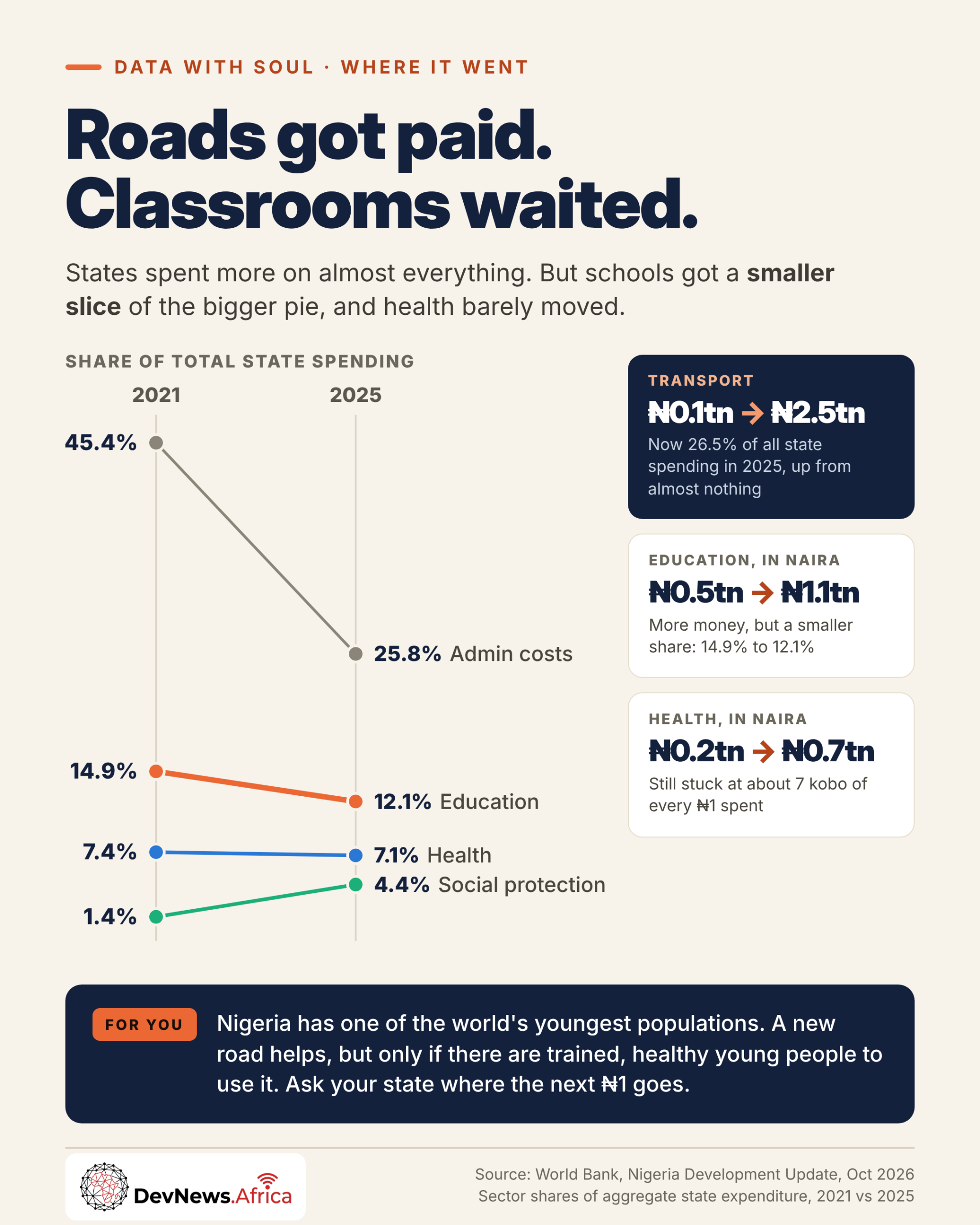
State spending on transport went from about ₦0.1 trillion in 2021 to ₦2.5 trillion in 2025. That is roughly 25 times more. Transport now takes 26.5% of all state spending, making it one of the largest spending categories.
Capital spending (money for building things rather than running government) rose 151% in real terms between 2023 and 2025. Its share of total state spending climbed from 48% to 61%. Housing, community amenities, agriculture and energy all got more too.
Some of this is good news. The share of spending on general administration, the overhead of running government, fell from 45.4% to 25.8%. Less money for running costs, more for building things, is what reformers have asked for over many years.
But look at the people side
Here is the part that should worry every young Nigerian.
- Education spending rose in naira, from about ₦0.5 trillion to ₦1.1 trillion. But its share fell from 14.9% to 12.1% of state spending.
- Health spending rose from about ₦0.2 trillion to ₦0.7 trillion. Its share barely moved, at about 7%.
- Social protection is the bright spot: its share tripled, from 1.4% to 4.4%.
In the World Bank’s words, spending on health, education and social protection “rose substantially but grew more slowly” than spending on infrastructure.
In plain terms: the pie got bigger, but schools got a thinner slice. Health stayed stuck at roughly 7 kobo of every ₦1.
Why it matters if you’re under 30
Nigeria has one of the youngest populations in the world. Most of us are either in school, just out of it, or trying to raise children who will soon be in it. Classrooms, teachers and clinics are where our futures are built, not just roads.
A new expressway helps you get to work. But if you never got a decent education, or you’re too sick to show up, the road can’t do much for you. The countries that turned a revenue boom into lasting prosperity invested in both.
To be fair, real social spending per person rose in all but one state between 2022 and 2025. So this isn’t a story of cuts. It’s a story of what came first and of what risks being left behind when the boom ends.
What you can do
- Look up your state’s education and health budget lines. Compare them with transport. The ratio tells you your governor’s priorities.
- Visit a public school or primary health centre near you. Count the teachers, nurses and working toilets. That’s the real budget report.
- If you’re a student leader or youth group: request a meeting with your state’s education commissioner. Bring the numbers from this article.
- If you’re job-hunting: remember that roads and buildings need maintenance, and schools and clinics need staff. Both are where public money is moving.
Our take at DNA
Infrastructure isn’t the enemy. But a state that builds flyovers while its classrooms crumble is only investing in half its future. The next round of state budgets should be judged on one question: did the people get as much as the projects?
Source: World Bank, Nigeria Development Update, October 2026. Report