
Category: Behind The Wire · Tags: Nigeria, Elections2027, Accountability, YouthVoices · Infographic: 5-state-scorecard.png
Excerpt: More money came in. In 26 states, even more went out. With elections ahead, the World Bank is warning about what comes next…
Imagine your salary nearly doubles. Then you start spending even faster than it grew. Your friends would call that a problem. The World Bank’s October 2026 Nigeria Development Update says many of Nigeria’s states are doing exactly that.
Spending is outrunning revenue
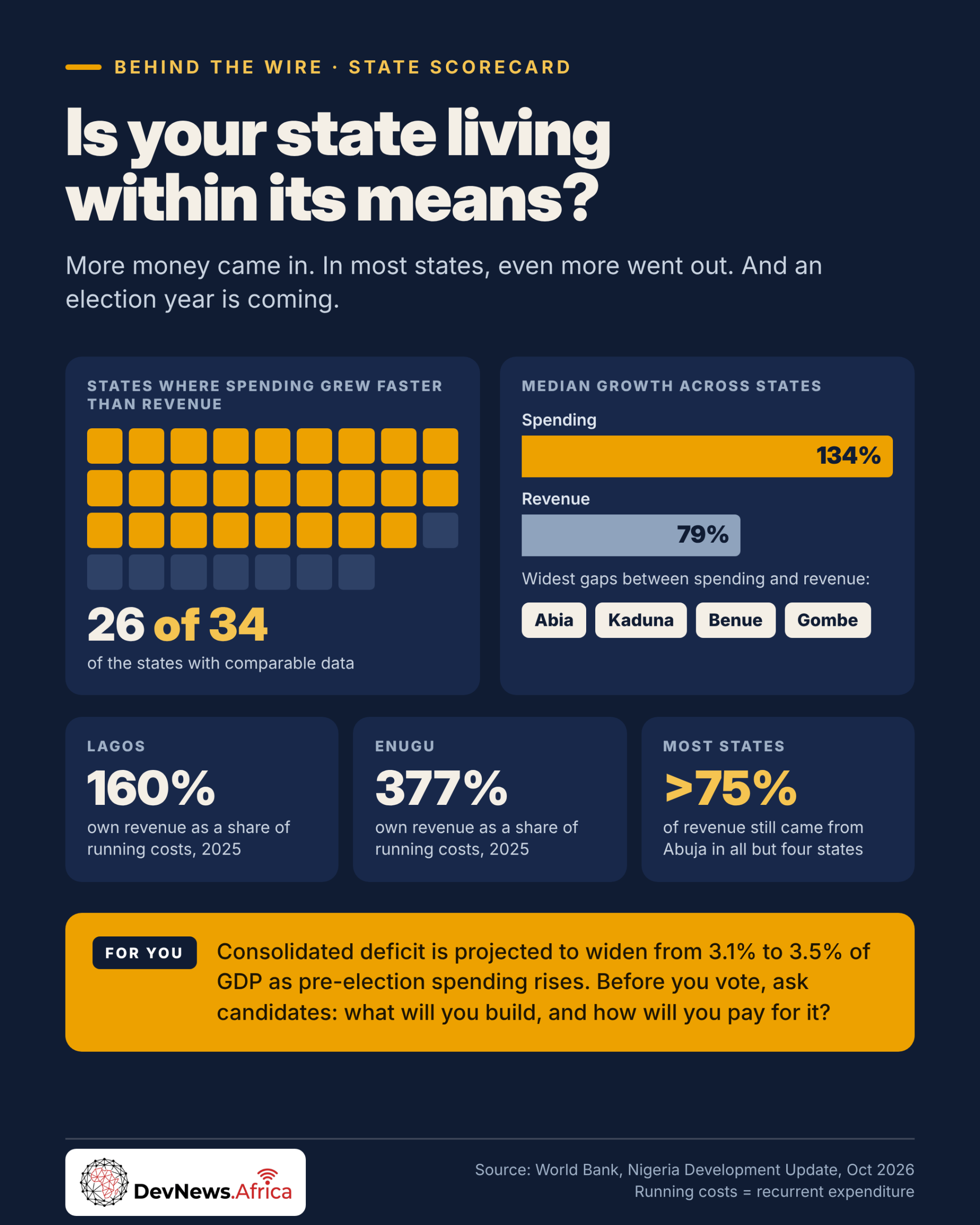
Out of 34 states with data, 26 increased spending faster than revenue. For the middle state, spending grew by about 134%, while revenue grew by about 79%.
The states with the widest gaps between spending and revenue are Abia, Kaduna, Benue and Gombe.
To be fair, this isn’t all bad. Much of the extra spending went on capital projects, and total state debt fell from 3.2% of GDP in 2023 to 2.8% in 2025. But spending faster than you earn only works for so long, especially when most of your income comes from someone else.
Most states still live on Abuja’s allowance
Federation transfers made up more than three-quarters of revenue in all but four states. Only two states, Lagos and Enugu, could cover their running costs (salaries, overheads) with the money they raise themselves:
- Lagos: own revenue equal to 160% of recurrent costs in 2025
- Enugu: own revenue equal to 377% of recurrent costs in 2025
Enugu’s story is striking. Its internally generated revenue jumped from ₦25 billion to ₦209 billion. Its direct assessment tax went from ₦280 million to ₦14.5 billion. That shows what better revenue administration can do.
For almost everyone else, a fall in oil prices or federation revenue would quickly squeeze state budgets.
The election factor
Here is where it gets personal. Nigeria’s next general elections are in early 2027, and pre-election spending is already rising. The World Bank projects that Nigeria’s consolidated fiscal deficit will widen from 3.1% of GDP in 2025 to 3.5% in 2026. It warns that spending pressure could reverse some of the hard-won fiscal gains.
We’ve seen this before. Campaign season brings flag-offs, unfinished projects and “stomach infrastructure.” Afterwards, the bills arrive often as unpaid salaries, abandoned sites and new borrowing that today’s young people will repay for decades.
What you can do
- Check where your state stands. BudgIT’s state rankings and your state’s own budget performance reports show revenue, spending and debt.
- Ask every candidate two questions: What will you build? and How will you pay for it without new debt? Record the answers.
- Watch for unfinished projects. Make a list of projects flagged off in your area since 2023 and check which are complete. Share it.
- Register and vote. Young Nigerians are the largest voting bloc. A state budget is shaped by whoever turns up.
Our take at DNA
The reforms gave states a once-in-a-generation windfall. Some used it to build lasting strength, like Enugu growing its own revenue more than eightfold. Others are spending ahead of their means into an election year. In 2027, the most important question to ask any governorship candidate isn’t what they promise. It’s how they’ll pay for it.
Source: World Bank, Nigeria Development Update, October 2026. Report