
Nigeria’s states are building on a scale not seen in years. If you want a job, a contract or a business idea, the World Bank’s latest report is a map…
Here’s a job-hunting tip nobody puts on LinkedIn: follow the cement.
Wherever governments are spending big on building things, people get hired. Engineers and artisans, drivers and caterers, suppliers and security guards. The World Bank’s October 2026 Nigeria Development Update shows exactly where Nigeria’s states are now pouring their money.
The map
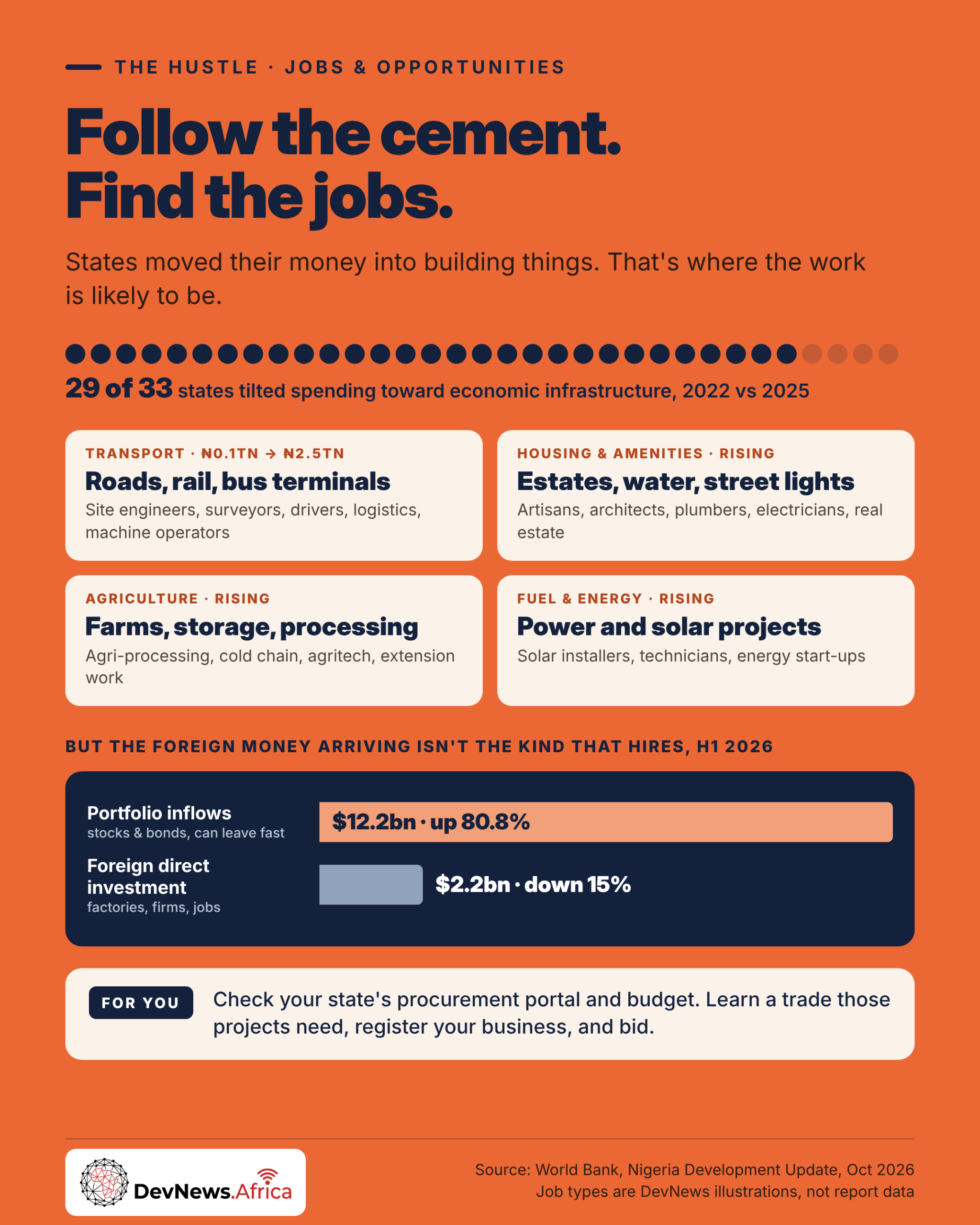
According to the report, 29 of 33 states with comparable data tilted their spending mix toward economic infrastructure between 2022 and 2025. Capital spending now makes up 61% of state budgets, up from 48% in 2023.
Here’s where the money is moving:
- Transport: from about ₦0.1 trillion (2021) to ₦2.5 trillion (2025). Roads, bridges, bus terminals, rail.
- Housing and community amenities: up. Estates, water schemes, street lights, markets.
- Agriculture: up. Farm inputs, storage, processing, rural roads.
- Fuel and energy: up. Power projects, solar mini-grids, street lighting.
Every item on that list needs people to plan it, build it, supply it and maintain it.
Where you could fit in
The report doesn’t list jobs, so this part is our read of the numbers:
- Skilled trades: welders, electricians, plumbers, masons, tilers and machine operators are in demand on every site. A trade certificate can pay faster than a second degree.
- Technical roles: civil engineers, quantity surveyors, site supervisors, GIS analysts and project managers.
- Supply and logistics: someone has to deliver the sand, cement, rods and diesel. Small transport and supply businesses can grow with these contracts.
- Energy: solar installation and maintenance is one of the fastest skills to learn and one of the most needed.
- Agri-processing: turning tomatoes into paste, cassava into flour, or running cold storage. Farm money creates jobs after the farm, too.
The warning sign
Not all money coming into Nigeria creates jobs. In the first half of 2026, portfolio inflows — foreign money buying Nigerian bonds and shares — jumped 80.8% to $12.2 billion. Meanwhile foreign direct investment, the kind that builds factories and hires workers, fell 15% to $2.2 billion.
Portfolio money can leave as fast as it arrived. That makes state-funded projects even more important for jobs right now. It also means these jobs depend on states keeping up their spending, which isn’t guaranteed (more on that in our next piece).
The job gap is huge, too. Nigeria needs roughly four million new jobs a year, according to the Nigeria Economic Summit Group. No single budget will close that.
What you can do
- Bookmark your state’s e-procurement portal. Many states publish tenders online. Small contracts are often within reach of registered youth-owned businesses.
- Register your business with CAC. You can’t bid for government work without it, and registration is cheaper than most people think.
- Pick a trade that matches the spending. If your state is building roads and solar, those are the skills to learn this year.
- Approach contractors directly. Find out who won the big contracts in your state and ask about apprenticeships, site jobs or subcontracts.
Our take at DNA
The money is moving into concrete, cables and farms. Young Nigerians who position themselves along that path — with skills, a registered business and a little boldness — stand the best chance of being paid by it. Don’t wait for the job ad. Follow the cement.
Source: World Bank, Nigeria Development Update, October 2026. Report
Job categories are DevNews.Africa analysis, not report findings.