
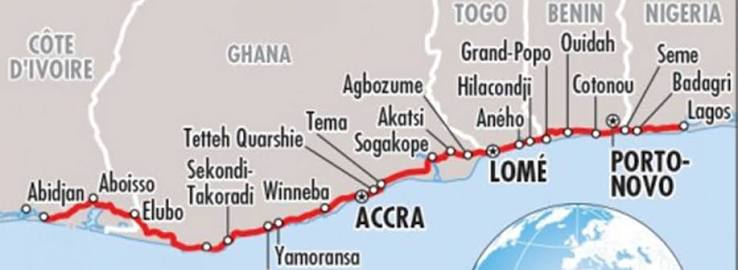
Let’s talk about a drive. Not a weekend getaway. A thousand-kilometer stretch of ambition running along West Africa’s coast. Abidjan to Lagos. Five countries. Millions of tons of goods. Millions of people. And for decades, a bottleneck of border checks, deteriorating asphalt, and economic friction that quietly drains the region’s potential.
This week, ECOWAS stopped treating it like a feasibility study and started treating it like a ledger. The Abidjan-Lagos Corridor Management Authority (ALCOMA) held its first board meeting. The $15 billion highway is no longer a concept. It’s entering the investment phase.
But here’s what the press releases won’t tell you: this isn’t just a road. It’s a political experiment. And if it works, it could rewrite how West Africa trades, moves, and grows. If it doesn’t, it’ll be another monument to announced ambition.
Let’s break down what’s actually happening, why it matters, and what could still go wrong.
THE MECHANICS (IN PLAIN ENGLISH)
Five sovereign nations – Benin, Côte d’Ivoire, Ghana, Nigeria, Togo – have agreed to treat a single stretch of infrastructure as one unified asset. No more five separate toll systems. No more customs delays at every border crossing. One supranational authority. One operating standard. One vision.
That’s ALCOMA. And it’s a big deal.
Historically, cross-border projects in Africa fracture under the weight of competing national interests. Different procurement rules. Different maintenance budgets. Different political cycles. ALCOMA is designed to bypass that. It’s a single governance framework for design, construction, and operation. Progressive opening starts around 2030.
The African Development Bank is stepping in as the Mandatory Lead Arranger. They’ve already deployed $25 million in technical assistance. They’re backing the corridor with $500 million in catalytic capital from the ADF-17 envelope, with additional allocations from Benin, Côte d’Ivoire, and Nigeria.
But $15 billion doesn’t materialize because a board signs a resolution. It materializes when viability gap funding closes. When land acquisition stops stalling. When private capital decides the risk is worth the return. And when maintenance isn’t an afterthought, but a locked-in budget line.
“A road is only as strong as the hands that maintain it.” – West African Proverb
THE HUMAN STAKES (BEYOND THE ASPHALT)
Strip away the macro numbers. Think about the person behind the statistic.
The woman hauling textiles across borders in a van that breaks down twice a trip. The agro-processor in Accra whose produce spoils before it reaches Abidjan because the road turns to mud in the rainy season. The young engineer in Lagos who knows how to build climate-resilient drainage but gets hired on day-rate contracts with no insurance.
This corridor isn’t just concrete. It’s economic oxygen. It’s meant to unlock a $734.8 billion regional market. It’s designed to feed directly into the African Continental Free Trade Area. And running parallel to the highway announcement? ECOWAS launched a new Gender and Trade Strategy in Lomé, specifically targeting the small-scale cross-border traders – mostly women – who’ve been navigating harassment, administrative walls, and financing deserts for years.
Because a highway means nothing if the people who actually move the economy can’t use it safely, affordably, or fairly. Trade facilitation isn’t a side project. It’s the engine.
“When the moon is shining, the cripple becomes hungry for a walk.” – Zulu Proverb
The moon is shining. But walking requires sidewalks, streetlights, and safe crossings.
THE REALITY CHECK (WHAT COULD STILL GO WRONG)
Announcing a corridor is easy. Building it is hard. Maintaining it is harder. Keeping five governments aligned when political cycles shift, currencies fluctuate, and elections change priorities? That’s the real test.
Land acquisition alone has killed more infrastructure projects in Africa than funding shortages. Environmental and social impact mitigation isn’t a compliance checkbox; it’s the difference between a project that uplifts communities and one that displaces them. And viability gap funding? That’s the polite term for “the toll revenue alone won’t cover construction.” If the structure isn’t transparent, if the financing model isn’t equitable, if the maintenance framework isn’t locked in before the first ribbon is cut – you’ll have a gleaming six-lane motorway that degrades in five years because nobody budgeted for the long haul.
Infrastructure isn’t destiny. It’s a multiplier. It amplifies whatever system you build around it. Good governance? It accelerates prosperity. Weak institutions? It accelerates decay.
“Well done is better than well said.” – African Proverb
THE DNA TAKE
The blueprints are drawn. The board is seated. The capital is being wired. But concrete doesn’t care about press releases. It cares about procurement integrity, engineering standards, and political will that outlasts election cycles.
The Abidjan-Lagos corridor isn’t a finish line. It’s a foundation. What West Africa builds on it will decide whether this becomes an economic artery—or another cautionary tale.
“If you want to go fast, go alone. If you want to go far, go together.” – Pan-African Proverb
Five countries. One road. One chance to get the architecture right.
The ledger is open. Now let’s watch what gets poured.
📬 TL;DR FOR THE TIMELINE GENERATION
ECOWAS activates ALCOMA to govern the $15B Abidjan-Lagos highway across 5 countries. AfDB leads financing with $500M catalytic capital + $25M technical assistance. Goal: seamless trade, climate-resilient infrastructure, AfCFTA integration. Parallel launch: ECOWAS Gender & Trade Strategy to protect small-scale (mostly women) cross-border traders. Success hinges on land acquisition transparency, viability gap funding, maintenance frameworks, and actual border harmonization—not just ribbon-cuttings.
Tags: #AbidjanLagosCorridor #ALCOMA #ECOWAS #Infrastructure #AfDB #WestAfrica #TradeFacilitation #YouthEconomy #DevNewsAfrica #NoJargon #RealTalk
SEO Meta: ECOWAS activates $15B Abidjan-Lagos highway board. DevNews.Africa breaks down what ALCOMA, AfDB financing, and the new gender-trade strategy actually mean for West African trade, jobs, and climate resilience.
Author: DevNews.Africa | Development news, minus the jargon. Plus the plot.