For years, every complaint about bad roads and empty clinics went to Abuja. The World Bank’s latest report says it’s time to redirect some of that energy to your governor…
Let us talk about where Nigeria’s money actually sits now.
For most of our lives, the script has been simple. Something goes wrong, we blame “the government,” and by government we mean Abuja. The President, the ministers, the National Assembly. The 36 state governments were the people who waited at the end of every month for their share of the federation pie.
That script is out of date. The World Bank’s new Nigeria Development Update (October 2026), titled Beyond the Federal Purse, puts numbers on a shift that has been quietly happening since the 2023 reforms.
The numbers
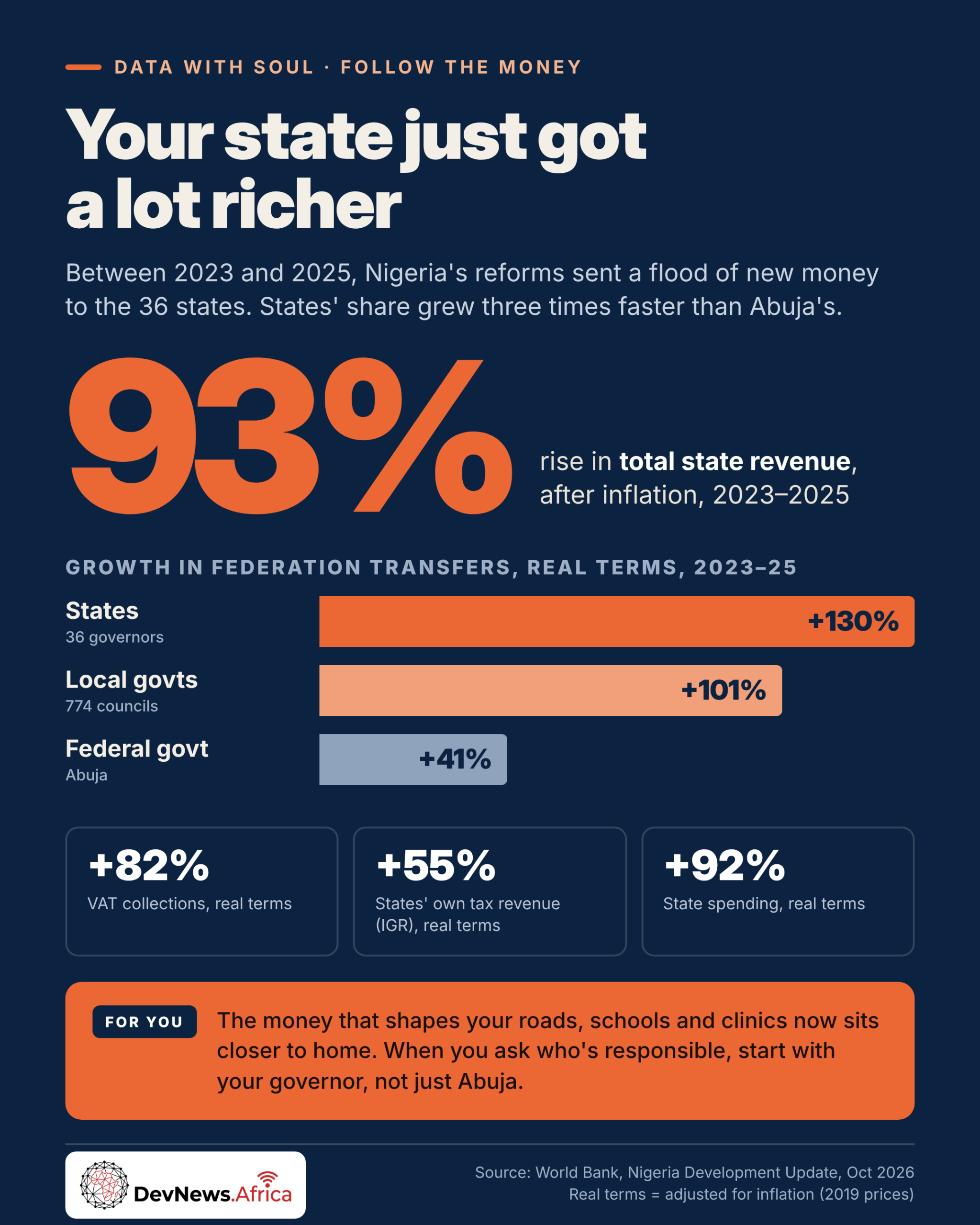
Between 2023 and 2025, total state revenue rose by about 93%. That is after adjusting for inflation, so it’s real money, not a trick of rising prices.
Where did it come from? Mostly from the same reforms that hurt your pocket. Removing the petrol subsidy and unifying the exchange rate meant far more naira flowing into the Federation Account. Better tax collection added more.
The bigger story is who got the most of that new money. In real terms, between 2023 and 2025:
- States’ share of federation revenue grew 130%
- Local governments’ share grew 101%
- The federal government’s share grew 41%
Read that again. The states’ cut grew more than three times faster than Abuja’s. VAT collections jumped 82%, and from 2026 the states’ statutory share of VAT has risen from 50% to 55%. States are also raising more of their own money: internally generated revenue (IGR) rose 55% in real terms.
So what? Here’s what it means for you
If you are a young Nigerian, this changes who you should be asking questions of.
The road from your house to the junction, the primary school your younger siblings attend, the health centre down the street, the water that may or may not come through the tap — most of these are state and local government business. And state governments now have more money to spend on them than at any point in recent years.
They are spending it. State spending rose about 92% in real terms over the same period. The question is no longer only “Is there money?” It is “Where is it going, and can I see it?”
The catch
More money is not the same as better lives. At the report’s launch, the World Bank’s Country Director for Nigeria, Mathew Verghis, called the revenue jump “a unique opportunity to improve infrastructure, education, healthcare, and water services.” An opportunity can still be wasted.
Most states still depend heavily on Abuja. Federation transfers made up more than three-quarters of revenue in all but four states. When oil prices or FX conditions change, that money can shrink as fast as it grew.
What you can do
- Find your state’s budget. Most states now publish approved budgets and budget performance reports online. Search “[your state] approved budget 2026.”
- Know your local government chairman. LGs saw their share jump 101%. Most young people can’t name theirs.
- Ask one specific question. Not “what is government doing?” but “how much did the state budget for the [named] road, and when will it be finished?”
- Follow the money with others. Civic groups like BudgIT and Follow The Money already track state spending. Join them, share their findings, ask your own questions.
Our take at DNA
The federal purse is no longer the only purse that matters. For the first time in a long time, your governor has more room to act than excuses. That makes 2026 the year to move your questions closer to home.
Source: World Bank, Nigeria Development Update, October 2026.
Download the report here: Report