
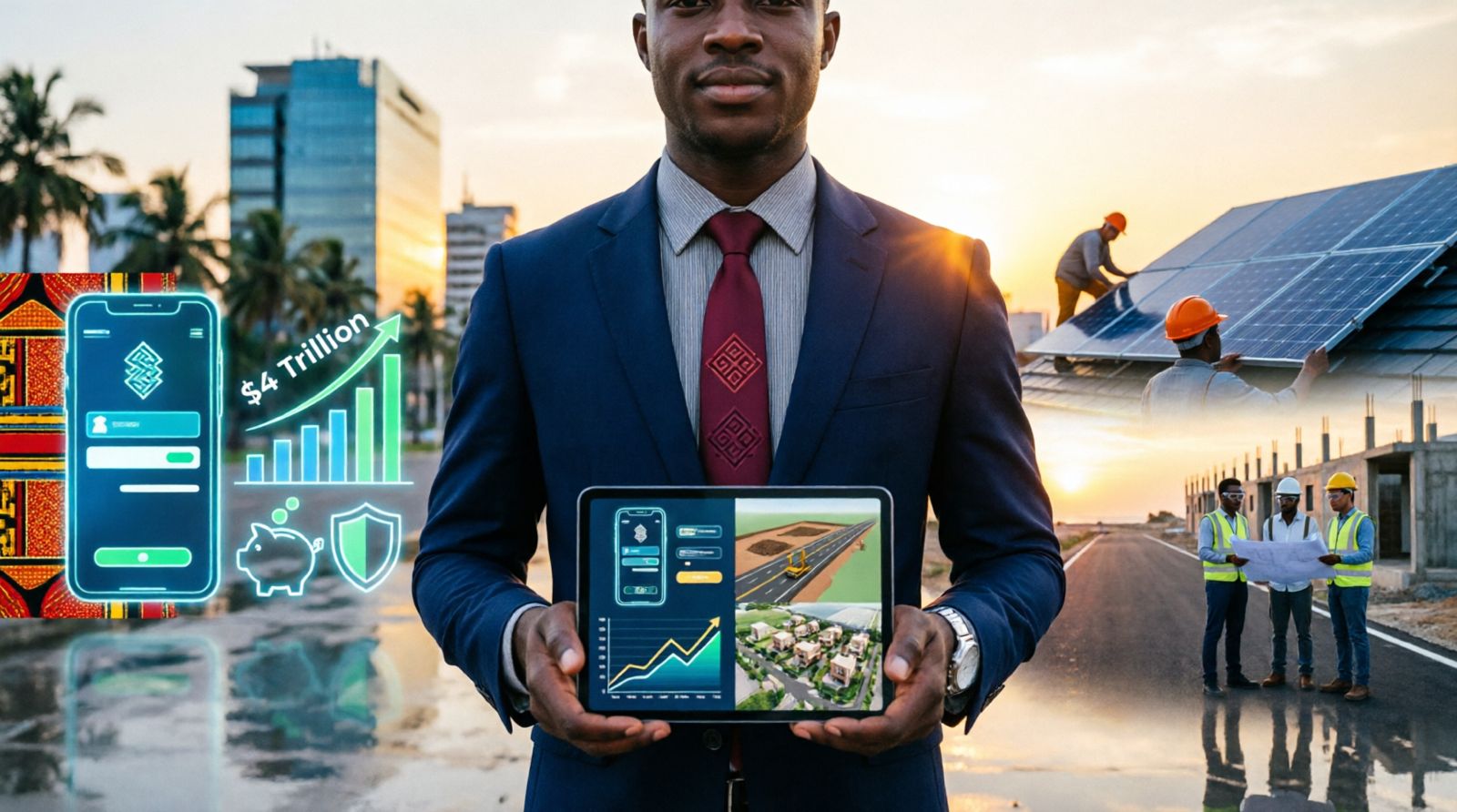
Let’s start with a number in our usual fashion: $4 trillion.
That’s how much long-term domestic savings Africa holds, according to President William Ruto speaking at the Africa Forward Summit in Nairobi last week.
Now here’s the twist: Africa also borrows billions every year from the World Bank, IMF, Eurobond markets, and bilateral lenders to fund the very projects that $4 trillion could theoretically cover.
So which is it? Are we broke or are we sitting on a fortune?
The answer, as it often is, is “yes” how ever you want to look at it.
The Official Story: “Africa Must Finance Africa”
Ruto’s message was clear: the continent can no longer rely heavily on external lenders to meet its infrastructure and economic needs.
He laid out the balance sheet:
- $4 trillion in long-term domestic savings
- $1 trillion+ in pension and insurance assets
- $500 billion+ in central bank reserves
And yet, governments still struggle to fund roads, energy projects, industrial parks, affordable housing, and transport corridors.
His diagnosis? “The issue, therefore, is not liquidity. It is risk architecture.”
In plain English? The money exists. The pipes to move it from savers to projects are clogged.
“A river that forgets its source will run dry.” — Yoruba Proverb
Africa’s source isn’t foreign aid. It’s African capital. But a source without a channel is just a puddle.
The Numbers Behind the Rhetoric
Let’s strip the speechifying and look at the actual flow of money.
What African Governments Generate (Domestically)
| Revenue Source | Typical Range (as % of GDP) | Reality Check |
|---|---|---|
| Tax revenue | 12-18% for most sub-Saharan countries | Low by global standards; informal economies are hard to tax |
| Non-tax revenue | 2-5% (fees, royalties, SOE dividends) | Volatile; often tied to commodity prices |
| Domestic borrowing | Varies widely; often 3-8% of GDP | Crowds out private sector; high interest rates |
What African Governments Borrow (Externally)
| Source | Typical Terms | The Catch |
|---|---|---|
| Eurobonds | 6-10% interest; 7-15 year maturities | Expensive; currency risk; refinancing cliffs |
| World Bank/IMF | 1-3% concessional; long tenors | Policy conditionality; slow disbursement |
| Bilateral lenders | Mixed; often tied to contracts | Geopolitical strings; transparency concerns |
| African institutions (AfDB, Afreximbank) | 3-6%; regional focus | Limited capital base; can’t meet demand alone |
The Gap
The African Development Bank estimates the continent’s annual infrastructure financing need at $130-170 billion. Current flows (public + private + external) cover maybe $70-90 billion.
Shortfall: $40-100 billion per year.
Now compare that to the $4 trillion in domestic savings Ruto cited.
That’s not a gap. That’s a disconnect.
Why the Money Isn’t Moving (The Real Story)
It’s not that African capital is lazy. It’s that the system isn’t built to deploy it at scale for development.
1. Risk perception is broken
Local pension funds are told: “Government bonds are safe. Infrastructure projects are risky.” So they buy T-bills yielding 12-18% instead of funding a solar plant that could yield 8% but create 500 jobs. The math is narrow. The impact is narrower.
2. Project preparation is underfunded
A bankable project doesn’t just appear. It needs feasibility studies, environmental assessments, legal structuring, financial modelling. That costs money upfront—money most African governments don’t have spare. So projects stay on PowerPoint.
3. Currency mismatch
Most institutional investors (pension funds, insurers) hold assets in local currency. But many large infrastructure projects require imported equipment, priced in dollars. Who absorbs the forex risk? Often, no one volunteers.
4. Fragmentation
Africa has 54 countries, 42 currencies, and dozens of regulatory regimes. A pension fund in Ghana can’t easily invest in a toll road in Tanzania. The capital is there. The cross-border plumbing isn’t.
“A single broomstick cannot sweep the compound.” — Yoruba Proverb
Capital needs coordination. Africa has capital. It’s still learning to coordinate.
The Human Stakes
Forget the trillions for a moment. Think about the person behind the statistic.
A young engineer in Lagos graduates with a degree in renewable energy. There are solar projects that need her skills. But the projects can’t get financing because local banks see “new technology” and think “high risk.” She emigrates. The project stalls. Everyone loses.
A smallholder farmer in western Kenya wants to install drip irrigation. The co-op has savings. The equipment is available. But there’s no loan product designed for group collateral, seasonal cash flows, and climate risk. He plants rain-fed. The drought comes. The harvest fails.
A city planner in Accra knows the informal settlement needs upgraded water lines. The municipal budget is tight. The central government is focused on highways. The residents can’t pay upfront. So the pipes stay broken.
These aren’t isolated cases. They’re the daily reality of capital that exists but doesn’t flow.
“When the moon is shining, the cripple becomes hungry for a walk.” — Zulu Proverb
The moon is shining. The question is whether the path will be cleared or just mapped.
What Ruto’s Pitch Gets Right (And What It Doesn’t)
✅ The Diagnosis
He’s correct: Africa’s problem isn’t a lack of savings. It’s a lack of structures to convert those savings into productive investment. “Risk architecture” is a wonky phrase for a real problem: how do you make a pension fund comfortable funding a rural mini-grid?
✅ The Prescription
Coordinating African financial institutions—AfDB, Afreximbank, Africa Finance Corporation, Trade and Development Bank, Shelter Afrique—is smarter than building 54 separate national development banks. Scale matters. Specialisation matters. Collaboration matters.
⚠️ The Gap
Saying “Africa must finance Africa” is a rallying cry. But rallying cries don’t rewire financial systems.
Who will:
- Standardise project preparation protocols across borders?
- Create credit enhancement facilities that de-risk investments for local institutional investors?
- Build the data infrastructure that lets a Ghanaian pension fund assess the creditworthiness of a Senegalese toll road?
- Ensure that “domestic capital” includes not just formal pensions but also informal savings groups, diaspora remittances, and SME retained earnings?
“Well done is better than well said.” — African Proverb
The speech was good. The execution will be harder.
Here’s our take at DNA
Africa does have enough capital to finance its own development.
But “having” capital and “deploying” capital are two different verbs.
The $4 trillion in savings isn’t a magic wand. It’s a resource. And resources only create value when they’re channelled with intention, integrity, and intelligence.
Ruto is right to call for African agency. But agency isn’t a slogan. It’s a system.
If African governments, financial institutions, and private investors can build the pipes to move domestic savings into productive projects on African terms, with African oversight, for African benefit, then yes, the continent can finance its own future.
If they can’t? The $4 trillion will keep sitting in accounts, earning modest returns, while the infrastructure gap widens and the next generation asks why the money was there but the roads weren’t.
“The truth is like a lion; you don’t have to defend it. Let it loose; it will defend itself.” — African Proverb
The truth here is simple: capital follows confidence. Build the systems. Earn the trust. Deploy the resources.
Africa has the money. Now it needs the machinery.
Source: https://www.the-star.co.ke/news/2026-05-12-ruto-asks-africa-to-finance-its-own-development-projects