
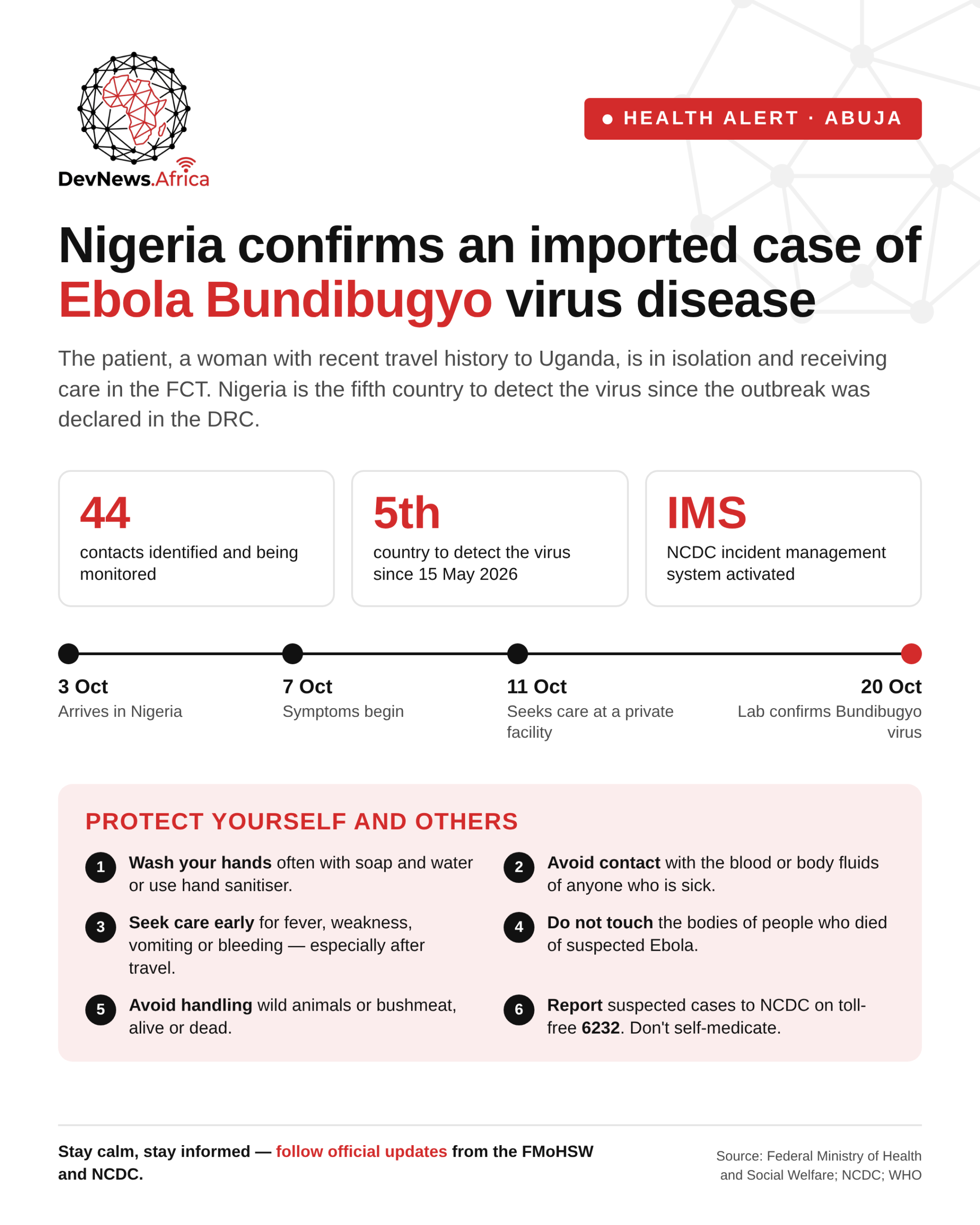
Nigeria has confirmed its first Ebola case of the current outbreak: a woman who arrived in Abuja from Uganda tested positive after initially being treated for malaria-like symptoms. She is isolated, and officials are monitoring 44 close contacts.
That alone is not a reason to panic. But it is a reason to pay attention because the next few weeks could affect flights, in-person work, client meetings, school routines, and how confidently people move around Abuja and other major cities.
Why this matters to you
If you are job hunting, running a small business, schooling , or planning travel, the risk is not just Ebola itself. It is the disruption that follows a public-health scare: extra airport screening, postponed events, nervous clients, and employers asking people to work remotely.
Nigeria has already heightened surveillance at international airports and land borders, including temperature checks, travel-history screening, and mandatory health-declaration requirements for travellers from certain higher-risk countries. The WHO is advising against blanket travel and trade restrictions, but governments and companies may still introduce precautionary measures that create friction.
The money angle
For founders and freelancers, the immediate cost is uncertainty. If clients postpone Abuja meetings, cancel conferences, or delay cross-border travel, that can mean delayed invoices, lost deal flow, and more time spent reassuring people instead of selling.
For workers, the practical question is whether your employer has a contingency plan. If your role depends on physical presence healthcare, logistics, hospitality, aviation, retail, events, or field salesyou may face new screening rules, schedule changes, or pressure to take precautions without clear support.
The gap nobody should ignore
The case reportedly spent several days in a private hospital before Ebola was confirmed, after presenting with malaria like symptoms. That is the real warning sign Nigeria’s response depends not only on airport checks, but on hospitals quickly asking the right travel-history questions and isolating suspected cases early.
Contact tracing is underway, with 44 contacts identified. That is encouraging but the system only works if people cooperate, health workers are protected, and information reaches the public quickly instead of turning into rumours.
What to do now
•If you travel: Check the NCDC health-declaration and screening requirements before booking or flying. Carry your travel history, keep digital copies of tickets and accommodation details, and expect longer airport processing.
•If you run a business: Review your events, client visits, and travel commitments for the next 30 days. Add a simple contingency like virtual meeting option, flexible rescheduling policy, and clear hygiene and sick-day rules for staff.
•If you are job hunting or working: Ask your employer three questions: What is the remote-work plan? Who pays for testing or time off if exposure occurs? What is the escalation process if a colleague shows symptoms?
•If you feel unwell after recent travel: Do not self-medicate and move around. Call ahead to a health facility, mention your travel history immediately, and follow their instructions.
•What to track: NCDC and Federal Ministry of Health updates, airline advisories, and whether more contacts test positive. The number to watch is not just “one case”it is whether contact tracing contains it quickly.
What to demand
Nigeria should not respond with panic bans. It should respond with competence rapid testing, protected health workers, transparent contact-tracing updates, practical support for affected businesses, and clear communication that separates evidence from fear.
The stakes are simple: if the response is fast and credible, this remains a contained public-health incident. If it is slow or unclear, the cost lands on young people trying to travel, graduate, build businesses, and access opportunities.