
You’ve heard words like “World Bank, AfDB, AFD” “funding,” and “impact.” But how does the money actually move? And why is everyone suddenly talking about “paying for results”?
“He who washes his hands clean can eat with elders.” — Igbo Proverb
Let’s start with a hard truth: development isn’t charity. It’s a transaction.
Governments in developing countries need capital to build roads, train teachers, fund clinics, and create jobs. But they don’t always have the tax revenue or borrowing capacity to do it alone. So they turn to development organizations: the World Bank, African Development Bank, USAID, UN agencies, and regional funds. These institutions pool money from wealthy nations, private investors, and global markets, then channel it to governments through structured agreements.
But here’s the catch: they don’t just hand over cash and walk away. They use frameworks. And for decades, the default framework was called IPF. Then came RBF.
If you don’t know what those acronyms mean, you’re already behind the conversation that’s deciding how billions are spent on your future. Let’s fix that.
The old playbook: Investment Project Finanancing (IPF)
What it is: Think of IPF as paying for the blueprint and the bricks. You submit a proposal: “We need $50 million to build 200 clinics.” The development bank approves it, releases funds in tranches, and you spend it on construction, equipment, and staff. You report receipts. They audit them. The cycle repeats.
The upside: It’s predictable. It funds physical infrastructure. Budgets are clear. You know exactly what’s being built, where, and by whom.
The downside: You get paid for activity, not outcome. You can build 200 clinics. But if they lack nurses, electricity, or medicine, they sit empty. You can run 50 youth training programs. But if graduates still can’t find jobs, the money didn’t change anything. The funding is spent either way.
“Well done is better than well said.” — African Proverb
IPF built schools that stayed quiet. It drilled wells that cracked in dry seasons. It funded “capacity building” that produced reports, not results. Donors noticed. Taxpayers noticed. And eventually, the system had to evolve.
The Pivot: Why Results Based Financing (RBF) became neccessary
By the 2010s, a pattern emerged: millions spent, but progress stalled on the metrics that actually matter to young people. Employment rates didn’t budge. Health outcomes lagged. Infrastructure deteriorated faster than it was maintained.
The problem wasn’t always corruption. Sometimes it was design. When funding rewards paperwork over performance, systems optimize for compliance, not impact.
Enter Results-Based Financing (RBF).
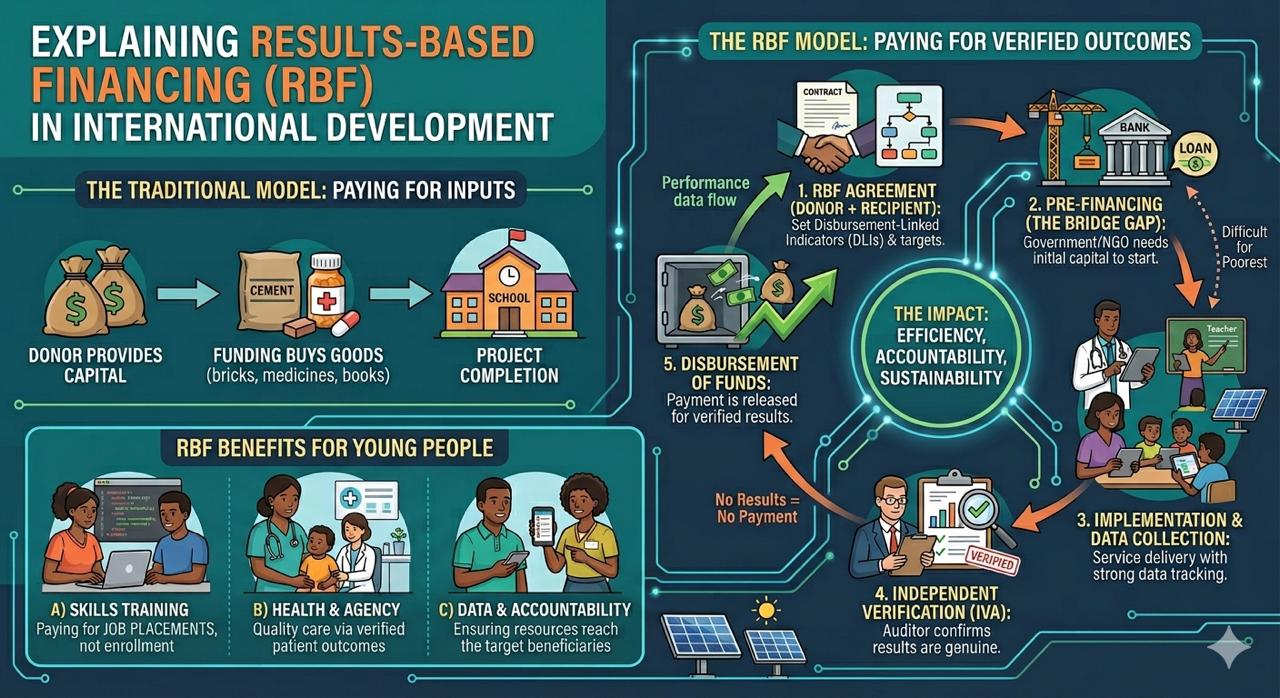
The premise is simple: stop paying for effort. Start paying for proof.
Instead of reimbursing a government for “holding training workshops,” you pay only when a verified number of graduates stay employed for six months. Instead of funding “clinic construction,” you fund “successful maternal deliveries with zero preventable complications.”
Money shifts from an upfront expense to a performance incentive.
The new playbook: How RBFs actually work
RBF isn’t one program. It’s a family of tools. They all share the same core mechanic: define the result → verify it → release the money. But they wear different suits depending on who’s using them.
| Tool | Who Uses It | How It Works in Plain English |
|---|---|---|
| Program-for-Results (PforR) | World Bank, AfDB | Funds a whole government program, but money flows only when independent audits confirm predefined outcomes (e.g., “increase rural electrification by 15%”). |
| Performance-Based Financing (PBF) | Gavi, Health Ministries | Clinics get bonuses based on verified metrics: immunization rates, patient satisfaction, treatment completion. No result? No bonus. |
| Fixed Amount Awards (FAAs) | USAID | Pays a flat sum when a specific milestone is hit: “$200,000 when the national youth employment portal processes 50,000 verified placements.” |
| Development Impact Bonds (DIBs) | Private Investors + NGOs + Donors | Investors front the cash. NGOs run the program. Donors repay investors only if independent verifiers confirm the results hit the target. If it fails, investors lose. Taxpayers don’t. |
Notice the shift? IPF asks: “Did you spend the money as planned?”
RBF asks: “Did the money change lives?”
“The frog that jumps without looking where it lands will end up in the chicken’s mouth.” — West African Proverb
RBF forces planners to look before they leap. But it’s not a magic wand.
Why this matters to you
If you’re 22, fresh out of university or vocational school, RBF directly shapes the programs targeting you.
Under IPF, a youth training center gets paid for enrollment. It doesn’t matter if the curriculum is outdated or if employers ignore the certificates. The money flows anyway.
Under RBF, that same center only gets paid when graduates land jobs and keep them. Suddenly, the center has to talk to employers, update its courses, provide internships, and follow up. The incentive flips from filling seats to creating pathways.
In health, RBF means clinics can’t just open doors. They have to keep patients coming back, track outcomes, and treat people with dignity. In agriculture, it means extension services get paid when farmers actually increase yields—not when they attend meetings.
“When the moon is shining, the cripple becomes hungry for a walk.” — Zulu Proverb
The moon is shining. But RBF only works if the path is real, not just mapped.
What we are watching
- The “creaming” trap: Will programs only serve the most “job-ready” youth to hit targets quickly, leaving behind those with disabilities, extreme poverty, or rural isolation?
- Measurement cost: Verifying results isn’t free. Independent audits, digital tracking, and data systems eat into funding. Will the verification machinery become heavier than the impact itself?
- Short-term bias: RBF rewards outcomes measurable in 1–2 years. Will long-term investments—mental health, civic leadership, climate adaptation—get sidelined because they’re harder to quantify?
- Local control: Will African governments design their own RBF frameworks, or inherit templates built in Washington, London, or Geneva?
- Private capital influence: Impact Bonds bring Wall Street into development. Will profit motives align with public good, or will programs chase “bankable” metrics over equitable ones?
The DevNews.Africa take
Money doesn’t create jobs. Systems do. But systems are shaped by how money is spent.
IPF wasn’t wrong. It was incomplete. It built the skeleton but forgot to wire the nerves. RBF isn’t perfect. It’s precise. It forces a hard question: Are we funding activity, or are we funding change?
For a generation tired of workshops that lead nowhere, degrees that don’t open doors, and “capacity building” that builds only more reports—RBF is a reset. Not a guarantee. A reset.
“The truth is like a lion; you don’t have to defend it. Let it loose; it will defend itself.” — African Proverb
The truth here is simple: impact is the new currency. But currency only has value when people trust it. Trust comes from verification. Verification comes from transparency. Transparency comes from asking the right questions.
Don’t just watch the funding headlines. Watch the results. Watch who gets paid. Watch who gets left out. Watch whether the metrics match your reality.
Because the people who design the payment triggers will design your future.
“If you want to go fast, go alone. If you want to go far, go together.” — Pan-African Proverb
Africa doesn’t need more promises. It needs proof. And proof, finally, is what the money is learning to follow.