
The World Bank just wrapped its Spring Meetings with a clear message: jobs cannot wait. Here’s what that actually means—for anyone tired of hearing “job creation” sounded out like a broken record.
“If you want to go fast, go alone. If you want to go far, go together.” — Pan-African Proverb
1.2billion young people in developing countries will enter the workforce over the next 10 to 15 years.
Now here’s the twist: Millions of them may not find work. Not because they lack skill. Not because they lack ambition. But because the systems designed to create jobs haven’t kept pace with the people who need them.
Last week in Washington, the World Bank Group and IMF held their Spring Meetings. The halls were packed. The conversations were urgent. And one message echoed across every room: jobs cannot wait.
In plain English? This isn’t a policy discussion. It’s a demographic countdown.
THE OFFICIAL STORY VS. THE MACHINERY
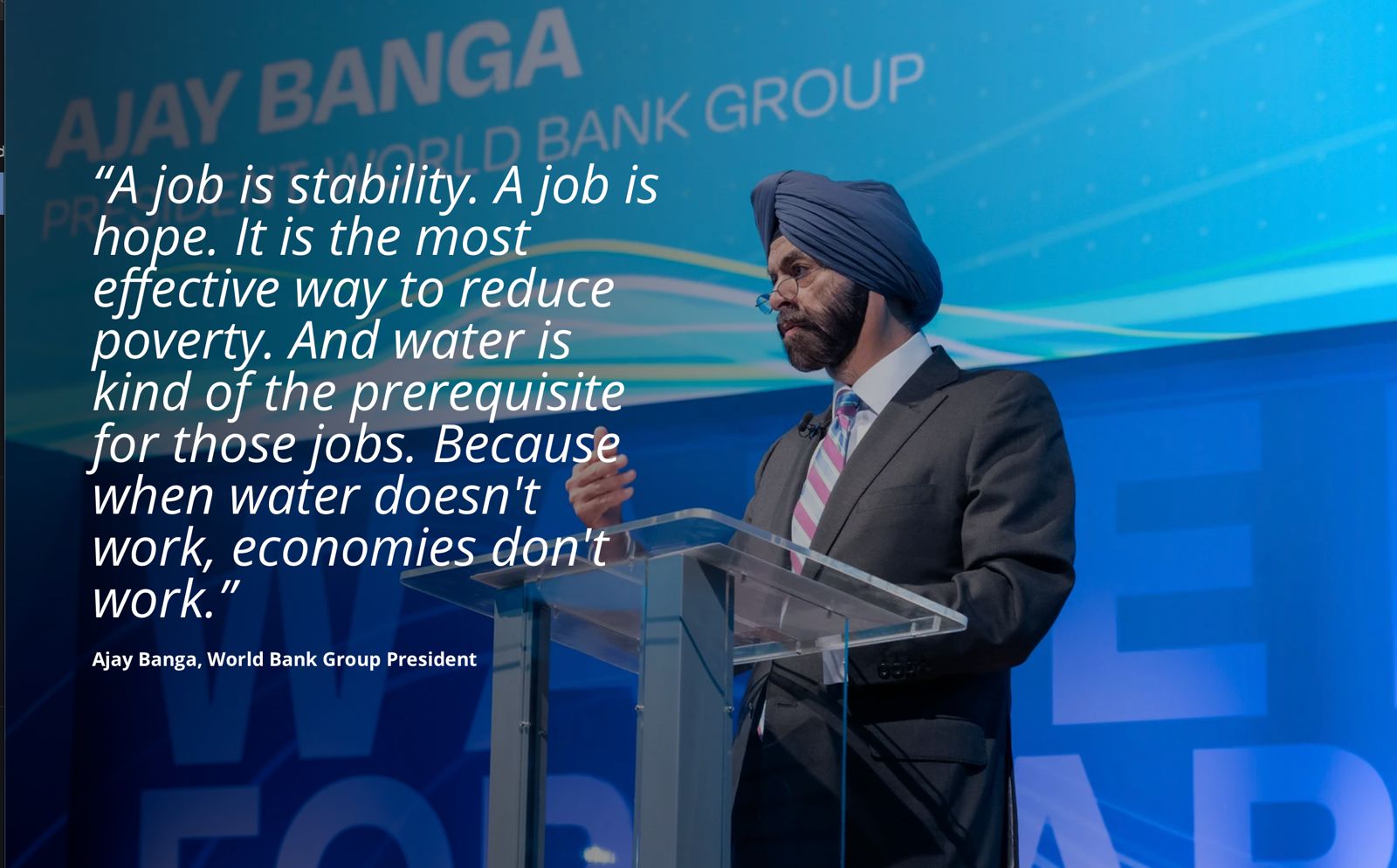
World Bank Group President Ajay Banga put it simply: “A job is stability. A job is hope. It is the most effective way to reduce poverty“.
The Bank’s jobs strategy rests on three pillars:
- Investing in foundational infrastructure—healthcare, education, skills
- Building a business-enabling environment
- Mobilizing private capital at scale
These aren’t bad ideas. They’re necessary ideas.
But ideas don’t hire people. Businesses do. And businesses need more than strategy documents. They need reliable power, affordable credit, functional supply chains, and customers with purchasing power.
That’s where Water Forward comes in. Launched at the Spring Meetings, this global platform aims to make water security a driver of jobs, investment, and growth. Fourteen countries have already launched water compacts—moving from fragmented projects to coordinated, system-wide solutions. The goal: improve water security for 1 billion people by 2030.
“Well done is better than well said.” — African Proverb
The question isn’t whether the targets are ambitious. It’s whether the execution will match the announcement.
THE HUMAN STAKES
Forget the billions for a moment. Think about the person behind the statistic.
Kwame in Accra has a degree in engineering. But without reliable electricity, she can’t run the software her job requires. Without affordable internet, she can’t apply for remote roles. Without a business environment that supports startups, she can’t create her own job.
A smallholder farmer in Tanzania wants to scale up. But without reliable water access, crops fail. Without cold storage, produce spoils. Without access to credit, he can’t invest in irrigation or equipment.
A young mother in Nairobi runs a small tailoring business. But without social protection, one health emergency wipes out her savings. Without access to capital, she can’t hire help or expand. Without broadband access, she can’t reach new customers online.
The World Bank highlighted progress on four 2030 targets during the Spring Meetings:
| Target | Goal | Progress So Far |
|---|---|---|
| Health Works | Connect 1.5 billion people to quality, affordable health services | 575 million reached; 45 countries scaled primary care |
| Mission 300 | Connect 300 million people in Sub-Saharan Africa to electricity | 43 million benefited; 135,000 businesses + 20,000 institutions connected |
| AgriConnect | Help 300 million small-scale farmers build thriving agribusinesses | 7 million farmers moved from subsistence to surplus |
| Unlocking Women’s Potential | Enable 300 million more women to use broadband; help 80 million access capital; support 250 million through social protection | Ongoing |
These aren’t just numbers. They’re lives.
“When the moon is shining, the cripple becomes hungry for a walk.” — Zulu Proverb
The moon is shining. The question is whether the path will be cleared.
WHAT WE’RE WATCHING
- Water Forward implementation: Will the 14 country compacts translate into reliable water services that actually enable businesses to operate and grow?
- Private capital mobilization: The World Bank notes that 90% of jobs in developing economies come from the private sector. Will guarantees and risk-sharing tools unlock the capital needed—or will investors remain on the sidelines?
- Measurement integrity: The new Targets Map and common MDB approach to measuring job outcomes aim to strengthen accountability. Will progress be reported transparently, with clear metrics and independent verification?
- Youth inclusion: Will young people—those most affected by the jobs crisis—have meaningful input into the policies and programs designed to address it?
- Crisis vs. structural reform balance: The Bank’s phased approach could mobilize $80-100 billion for crisis response while maintaining focus on long-term job creation. Will short-term interventions complement—or compete with—structural reforms?
THE CLOSE
Jobs aren’t created by announcements. They’re created by ecosystems.
The World Bank’s Spring Meetings delivered clarity on ambition. The next test is execution.
Water Forward won’t create jobs by itself. But reliable water systems enable factories to run, farms to irrigate, and communities to thrive. Mission 300 won’t end energy poverty overnight. But every new connection is a student who can study after dark, a clinic that can store vaccines, a business that can operate past sunset.
“The truth is like a lion; you don’t have to defend it. Let it loose; it will defend itself.” — African Proverb
The truth here is simple: 1.2 billion young people are waiting. Not for speeches. Not for strategies. For opportunity.
The World Bank has outlined the pillars. Countries have launched compacts. Tools have been introduced to track progress. Now comes the hard part: turning targets into tangible change.
“A single broomstick cannot sweep the compound.” — Yoruba Proverb
No single institution can meet the jobs challenge alone. But together—with accountability, with urgency, with centering the people most affected—progress is possible.