
Why so many NGOs and development bodies fail the people they set out to help, and what we must do instead.
A friend of mine wants to start an NGO to end tribalism. Her evidence, offered almost as a confession, was her own mother, a woman who stiffens the moment she learns that someone is from the north. My friend’s plan is to hold community engagements and change minds like her mother’s.
I asked her one question in return: had she ever stopped to consider why that mindset exists in the first place?
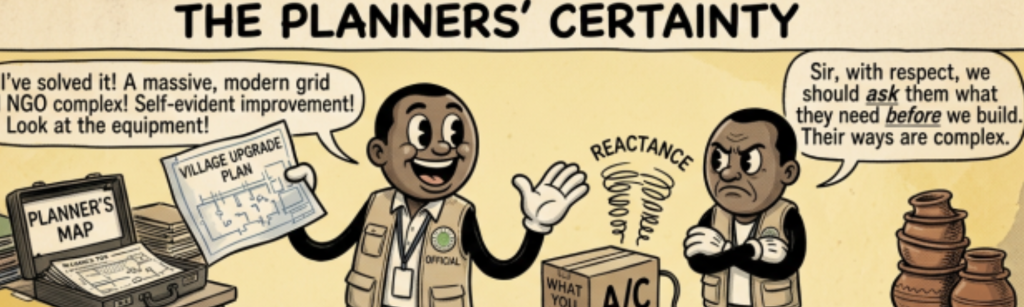
Not to defend it, but because projects like hers tend to fail in the same predictable way. Someone decides a community is wrong, arrives to correct it, and is genuinely wounded when the community declines to be corrected. I put it to her plainly: if you turned up at my door uninvited and demanded to be fed, I would refuse you, not because I doubt you are hungry, but because it is my door. The demand is the offence, not the need behind it. And the part most people miss is that arriving to save me works exactly the same way. Offer me help I never asked for and I will bristle, because beneath every unsolicited intervention runs a quieter sentence: I have decided what you need, and it did not occur to me to ask.
Psychologists have a name for that reflex: reactance. Threaten a person’s sense that the choice is theirs, and they will push back, often against their own interest, simply to make it theirs again.
Consider the image every development brochure loves: a family gathered around a fire at night, no electric light in sight. The outside eye reads deprivation instantly. Yet the wealthy now pay handsomely to go “off-grid,” and nobody calls that deprivation; we call it wellness. The scene is identical; the only thing that differs is whether the fire was chosen. And when Kenneth Lee, Edward Miguel and Catherine Wolfram actually tested the confident assumption that everyone must want the grid, offering rural Kenyan households connections at randomly varied prices, the assumption buckled. Demand fell steeply as the price rose, the households that did connect barely used the power, the benefits came in below what the connection cost, and income, health and schooling did not move. That is not proof that people are content in the dark. It is proof that the planner’s certainty about what they wanted was simply mistaken.
Which brings me to the hardest case, the one my friend actually cares about.
Ask why the mindset exists, and the answer turns out to be uncomfortably rational. Where the state is weak, where the courts cannot be relied upon, where there is no insurance and no job to be had on merit alone, someone must still settle your disputes, lend to you when the harvest fails, and find your child work. Across much of Nigeria, that someone is your ethnic and kin network. Seen in that light, favouring your own is less a moral defect than an insurance policy taken out against a state that offered you none. And the mistrust beneath it runs too deep to lecture away: Nathan Nunn and Leonard Wantchekon have shown that the regions of Africa raided most heavily during the slave trade remain, to this day, the least trusting of neighbours, of relatives, even of local government. You cannot talk a person out of an equilibrium that four centuries helped to build.
None of which means minds cannot change. They can, but through the environment, not the sermon. Edward Miguel studied two districts sitting on either side of a colonial border, one Kenyan and one Tanzanian, otherwise alike. Tanzania had spent decades on deliberate nation-building: a single national language, a shared curriculum, institutions designed to mix people rather than sort them. The heavy penalty that ethnic diversity imposed on school funding in Kenya all but vanished on the Tanzanian side of the line. Change what cooperation costs, and the minds come along behind.
I press this point because it is my own field, and the uncomfortable truth is that the work runs on persuasion. To get anything done you spend your days appealing (to donors for grants, to governments for permission, to boards for next year’s budget), and you learn quickly that money does not follow uncertainty. The pitch that wins is the confident one: the need self-evident, the remedy proven, the impact all but guaranteed. So, the field rewards certainty long before it rewards being right, and it keeps multiplying: Nigeria’s registered NGOs grew from roughly 17,000 in 2019 to more than 190,000 by 2023, and India now counts some 3.3 million, about one for every four hundred citizens. Yet the share of all that work ever tested to see whether it actually helped stays vanishingly small, which is exactly why the studies that follow were treated as news.
And the failures are not hypothetical: some of them are ours. A cleaner cookstove seems beyond argument: less smoke in the lungs, fewer emissions in the air. Yet when Rema Hanna, Esther Duflo and Michael Greenstone followed one such stove through four years of rural Indian life, the early gains dissolved. People used the stoves erratically and let them fall into disrepair, because the stove had been designed for a household that existed only in the laboratory.
And the error is not fading with time; it is being repainted green. The intervention is no longer even for the community; it is for the planet, and “the planet needs this” is fast becoming the new “these people need this,” a cause so self-evidently good that pausing to ask the people in its path begins to feel like obstruction. In Uganda, Oxfam documented some 22,500 people cleared from land they had farmed for decades to make way for a carbon-credit plantation, evicted in defiance of court orders while the project’s own paperwork recorded their departure as voluntary. In Norway (wealthy, democratic, scrupulous), the state raised part of Europe’s largest onshore wind farm on Sámi grazing land, and its own Supreme Court ruled that the turbines violated the Sámi’s right to practice their culture. The turbines are still turning.
The more righteous the cause, the more optional the asking comes to feel. But the asking is the whole of it: the single step that divides help from harm.
So my friend can indeed help reduce tribalism. What she cannot do is walk into a room as the one person holding the right mindset and expect the rest to receive it. The real work is duller and harder than that: to change the incentives that keep the old strategy sensible. To make it true that the court is fair, that the job goes to the deserving, that the road reaches your town however you voted. Fix the environment, and the mindset will follow it.
Attempt the reverse, scolding the mindset and leaving the environment untouched, and people will treat you exactly as I would treat the stranger at my door demanding to be fed.
They will resist. And they will be right to.