
There’s a moment in every parent’s life when a fever stops being just a fever.
It’s 2 AM. The child is burning up. The nearest clinic is an hour away on a road that doesn’t exist when it rains. You do what parents everywhere do: you hold them, you pray, you wait for morning.
Now imagine that moment multiplied by 438,000.
That’s how many African children died from malaria in 2024 alone.
And now imagine one in eight of those deaths… not happening.
That’s not a projection. That’s what just happened in Ghana, Kenya, and Malawi.
What Actually Changed
A study published this week in The Lancet looked at four years of real-world data from the first three African countries to roll out the RTS,S malaria vaccine.
The result? Among children who were eligible to receive the vaccine, an estimated 1 in 8 deaths from malaria were averted.
Let that number sit.
One in eight.
Not “maybe.” Not “in modelling.” Not “if everything goes perfectly.” In actual communities, with actual children, over actual years.
Dr. Kate O’Brien of WHO put it plainly: “This is very solid evidence of the potential for malaria vaccines to change the trajectory of child mortality in Africa.”
Translation: we finally have proof that this works at scale.
The Part Nobody Talks About
Vaccines don’t save lives by themselves. Systems do.
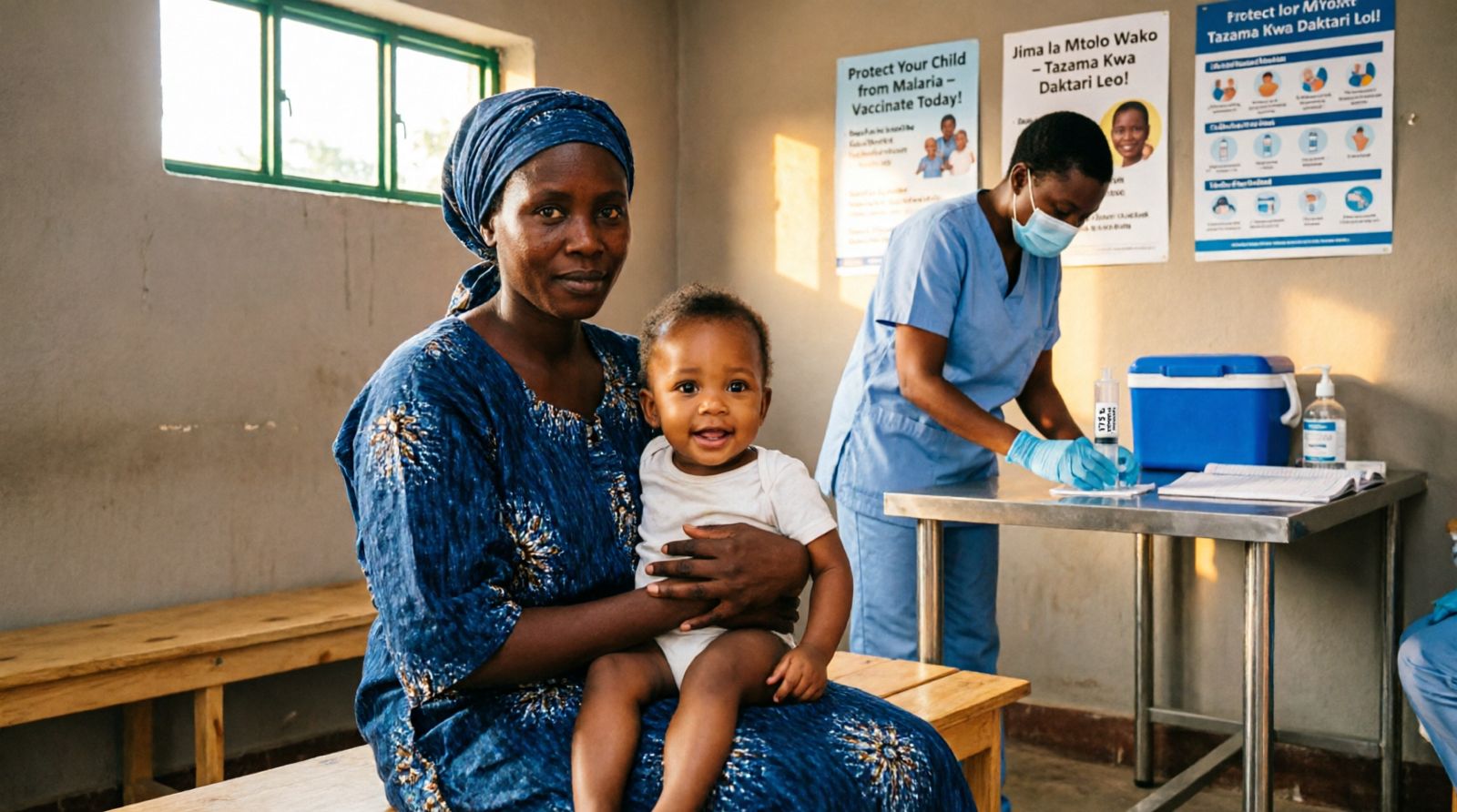
The RTS,S vaccine requires four doses. That means four health visits. Four chances to check a child’s growth, update their immunisations, distribute insecticide-treated nets, or provide vitamin A supplements.
The study found something quietly powerful: introducing the malaria vaccine didn’t reduce uptake of other childhood vaccines. It didn’t distract from bed net distribution. If anything, it pulled more children into the health system who weren’t reaching it before.
That’s not a side benefit. That’s design.
“It takes a village to raise a child.” — Igbo Proverb
But villages need tools. And now we have one that works.
Why This Isn’t Just a “Win” Story
Because 25 African countries are now offering malaria vaccines but most can’t afford to reach all the children who need them.
Supply isn’t the problem. Demand isn’t the problem. Money is.
WHO-recommended malaria vaccines (RTS,S and the newer R21) exist. Manufacturers can produce enough. Countries want to use them. But national budgets are tight, donor funding is unpredictable, and “scale-up” often means “slow-walk.”
So while the science celebrates, the logistics stall.
And children keep getting sick.
“The frog that jumps without looking where it lands will end up in the chicken’s mouth.” — West African Proverb
We’ve looked. We’ve landed. Now we have to walk.
The Human Arithmetic
Forget the percentages for a second.
Think about Amina in northern Ghana, whose youngest survived the last rainy season because she got the third dose on time.
Think about Dr. Mwenda in western Kenya, who now has one more tool to offer worried parents and one more reason to believe the system can work.
Think about the community health worker in rural Malawi who walks an extra five kilometres to reach a village that finally has access to both bed nets and vaccines.
These aren’t case studies. They’re the point.
The study confirms what frontline workers have suspected: when you give communities proven tools, they use them. When you make prevention accessible, people show up. When you trust the system, the system delivers.
The Bottom Line
Science gave us a tool. Data proved it works. Now politics and finance get to decide who benefits.
One in eight is not a ceiling. It’s a floor.
If funding catches up with evidence, if delivery matches design, if trust meets access, this number could get even better.
“The sun does not forget a village just because it is small.” — West African Proverb
Neither should we.
Source: https://www.who.int/news/item/malaria-vaccine-evaluation-lancet-2026